What Is Chikankari? History, Fabric, Making Process & Why Lucknow Owns This Craft
Everything you need to know about Chikankari — in one complete guide.
You have seen it on a hundred kurta tags. You have admired the delicate stitched flowers on someone's dupatta and wondered — what exactly is Chikankari? Where does it come from? How is it made? And is what I am looking at actually the real thing?
This guide answers all of it — the history, the city, the fabric, the process, the stitches, and the brand that is bringing authentic Chikankari to every Indian woman's wardrobe. Read it once and you will know Chikankari better than most people in India.
"Chikankari is not a fashion trend. It is a 400-year conversation between needle, thread, and soul."
TABLE OF CONTENTS
1. What Is Chikankari?
2. Origin of Chikankari — History & Mughal Roots
3. Why Is Lucknow Famous for Chikankari?
4. Fabrics Used in Chikankari
5. Traditional Chikankari Designs & Motifs
6. How Is Chikankari Made? — Step-by-Step Process
7. 36 Types of Chikankari Stitches Explained
8. AM Chikankari — Authentic Lucknow Brand
9. Shop AM Chikankari Kurtis Online
10. FAQs About Chikankari
1. What Is Chikankari?
Chikankari (pronounced chi-KAN-kaa-ree) is a traditional hand embroidery craft that originated in Lucknow, Uttar Pradesh, India. The word comes from the Persian 'Chikeen' — meaning delicate embroidered fabric — and 'Kari,' which means craft or work in Urdu.
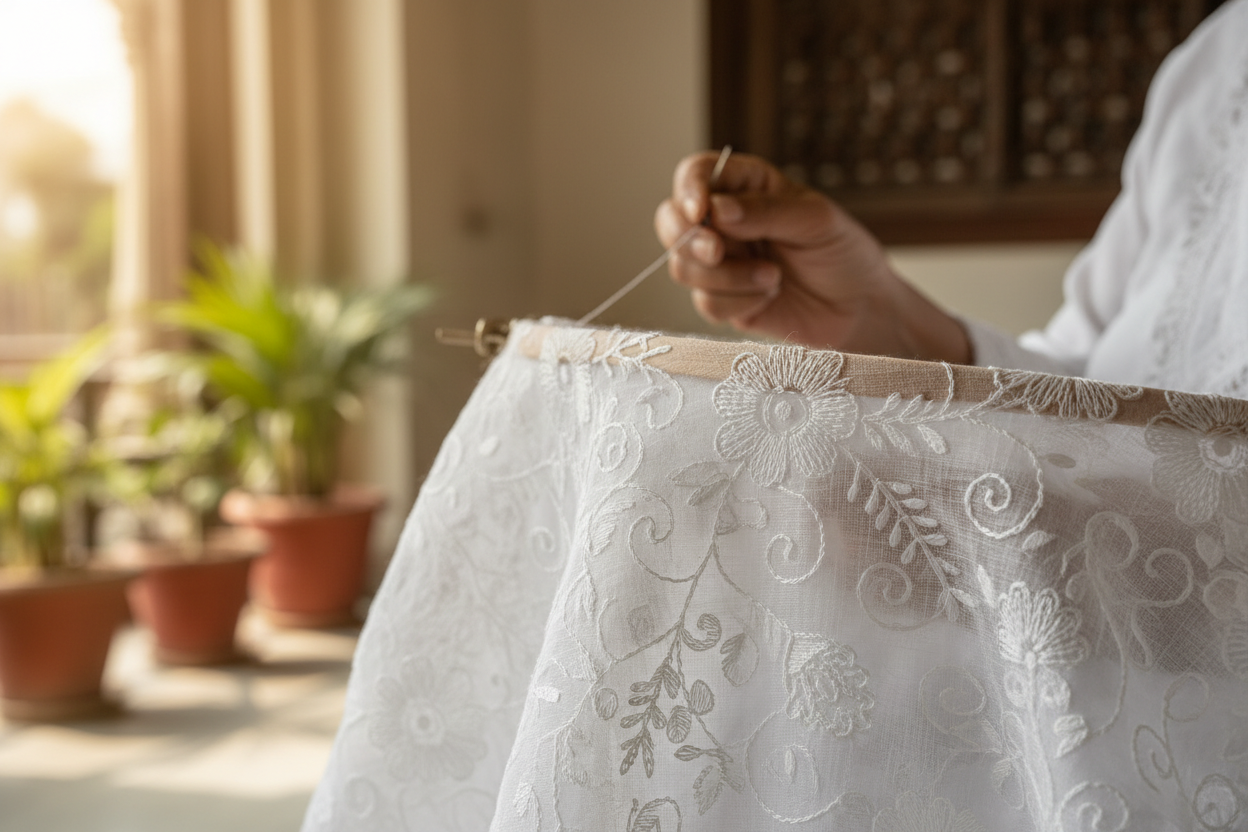
At its core, Chikankari is the art of stitching intricate floral and geometric patterns onto fine fabric using a needle and white or colored thread. What makes it unlike any other embroidery in the world is its signature subtlety — the patterns reveal themselves only when the fabric moves or catches light, creating an effect that textile historians have called 'embroidery that breathes.'
Traditional Chikankari uses white thread on white or pastel fabric, creating a shadow-play effect through a technique called bakhiya (shadow work). Today, colored thread Chikankari is equally popular — but the soul of the craft remains the same: patience, precision, and the human hand.
2. Origin of Chikankari — History & Mughal Roots
The story of Chikankari begins approximately 400 years ago in the courts of the Mughal Empire. Most historians credit Nur Jahan — the brilliant and artistically gifted wife of Emperor Jahangir — with introducing this fine embroidery style from Persia to the Indian subcontinent. Under her patronage, Indian artisans adapted the Persian craft into something uniquely their own, layering it with local Indian motifs, Mughal architectural patterns, and the extraordinary softness of Indian cotton.
The Nawabi Era: Chikankari's Golden Age
The craft truly blossomed under the Nawabs of Awadh, who ruled Lucknow from the mid-18th to mid-19th century. The Nawabi court was legendary for its refined taste — poetry, music, food, dance, and fashion were all elevated to art forms. Under Nawabi patronage, Chikankari evolved into one of the most technically complex textile crafts in the world.
Artisans competed to create pieces on fabric so fine it was called baft hawa ('woven air') and aab-e-rawan ('running water'). Over 36 distinct hand-stitch techniques were developed, codified, and refined across generations. That legacy survives today — in the hands of Lucknow's artisans, and in every AM Chikankari kurta.
3. Why Is Lucknow Famous for Chikankari?
Lucknow and Chikankari are legally and culturally inseparable. Lucknow Chikankari holds a Geographical Indication (GI) tag from the Government of India — which means only hand-embroidered work produced by artisans in and around Lucknow can be legally sold as 'Lucknow Chikankari.' No other city in the world holds this right.
Why is Lucknow the only true home of this craft? Four reasons:
• 400 years of unbroken royal patronage — from the Mughals to the Nawabs — concentrated the best artisans and techniques in Lucknow
• An estimated 2.5 lakh (250,000) artisans work in the Chikankari industry in and around Lucknow today, mostly women working from home
• Generations of artisan families in Lucknow's Chowk area have passed this craft from mother to daughter in an unbroken chain
• The local availability of fine cotton, mulmul, and the soft Gomti river water — traditionally believed to give Lucknow Chikankari its characteristic finish after washing
"Every Chikankari kurta is a postcard from Lucknow — carrying in its stitches the patience and pride of the city that invented this craft."
4. Which Fabrics Are Used in Chikankari?
The fabric is as important as the embroidery itself. Authentic Chikankari requires fabric fine enough for the needle to pass smoothly, strong enough to hold the stitches, and soft enough to carry the embroidery without stiffness. Here are the main fabrics used:
Mulmul (Muslin Cotton) — The Original Chikankari Fabric
Mulmul is the oldest and most prized Chikankari fabric — the same used in the Nawabi courts. It is extremely lightweight, loosely woven, and nearly transparent. The embroidery on mulmul glows with a luminous shadow quality when held to light. Best for: summers and casual daily wear.
Pure Cotton — Most Versatile
Slightly heavier than mulmul, pure cotton Chikankari kurtis are durable, easy to wash, colorfast, and available in a wide range of colors. They maintain their shape across many washes. Best for: everyday wear, office, and regular ethnic dressing.
Cambric Cotton — Most Structured
A tightly woven, smooth cotton that gives a formal, crisp look. Chikankari on cambric looks professional and tailored — the embroidery sits neatly on the surface. Best for: office wear and semi-formal occasions.
Cotton-Linen Blend — Natural Texture
Brings together linen's natural texture and cotton's softness. Creates a relaxed, artisanal feel with excellent breathability. Best for: casual outings, weekend wear, and the woman who wants her Chikankari to feel effortless.
Georgette & Chanderi — For Festive Occasions
Fabrics with a subtle natural sheen, used for premium and festive Chikankari sets. The sheen of the fabric elevates the hand embroidery to a celebratory level. Best for: weddings, Eid, Diwali, and special occasions.
5. Traditional Chikankari Designs & Motifs
Chikankari has a rich design vocabulary built over 400 years — a visual language drawn from nature, Mughal architecture, and the artisan's imagination. Here are the most important traditional motifs:
Kairi (Paisley / Mango Motif) — One of the oldest motifs in Chikankari, inspired by the curved shape of a mango. Appears on borders, necklines, and as central design elements.
Phool Patti (Flowers & Leaves) — The most common and versatile design family — flowers in every variety, climbing vines, individual leaves, and bouquets. Every authentic Chikankari piece features phool patti in some form.
Jali (Lattice Work) — Fine grid or lattice patterns that create a lace-like, airy effect on the fabric. One of the most technically demanding Chikankari designs — requires extraordinary precision.
Murghabi (Duck Motif) — A classic traditional motif featuring stylized ducks in repeating patterns. One of the most recognized and historically significant Chikankari designs.
Hatha Phool (Palm Flower) — A palm-sized floral cluster placed strategically on the chest, sleeve, or hemline as a bold visual focal point.
Bijli (Lightning / Zigzag) — Geometric zigzag patterns used for borders and as fill between floral motifs, adding visual energy to the overall design.
At AM Chikankari, our design team works with master craftsmen in Lucknow to blend these traditional motifs with contemporary cuts and color palettes — creating collections that feel rooted in heritage and completely modern at the same time.
6. How Is Chikankari Made? — Step-by-Step Process
This is the part most Chikankari blogs skip — but it is the most important. Understanding how Chikankari is made will change forever the way you look at every embroidered piece you hold. Every AM Chikankari kurta goes through this full, authentic eight-step process:
Step 01: Fabric Selection & Preparation
The correct fabric grade is chosen based on the garment. The fabric is pre-washed to remove sizing and stiffness, dried in shade, then cut into garment panels — kurta front, back, sleeves — but left unstitched so the embroiderer works on a flat surface.
Step 02: Block Printing the Design (Chhapayi)
The design is not drawn freehand — it is transferred using hand-carved wooden blocks dipped in a washable blue dye. The block printer (chappayi kaarigar) presses each block onto the fabric with precise, even pressure, transferring the full pattern. This blue guide dye disappears completely during washing.
Step 03: Embroidery (Kaari) — The Heart of the Process
The block-printed fabric goes to the Chikankari artisan — most often a woman working from her home in Lucknow. Using a fine needle and white (or colored) thread, she stitches the design following the blue-printed guide. A single kurta can take 2 to 6 weeks to embroider, depending on design density. Heavily embroidered pieces can take longer.
Step 04: Quality Check (Jaanch)
After embroidery is complete, the piece is inspected by a senior craftsperson for stitch consistency, density, and correctness. Areas where the embroidery is uneven or incorrect are returned for correction before proceeding.
Step 05: Washing (Dhobi Process)
The embroidered fabric is hand-washed by a specialized dhobi to remove the blue block-printing dye completely. The fabric is gently squeezed — never wrung — and dried flat in shade. After washing, the true Chikankari is revealed: white thread on clean fabric, the design emerging fresh and clear as if it had always been there.
Step 06: Finishing & Pressing
Thread ends are secured, any finishing embellishments are added, and the fabric panels are pressed with a warm iron on the reverse side — protecting the embroidery — to prepare them for tailoring.
Step 07: Tailoring (Darzi Work)
The finished embroidered panels are stitched into the final garment by skilled tailors who specialize in constructing kurtas to showcase Chikankari at its best — correct motif placement, clean seams, and a well-fitted silhouette.
Step 08: Final Quality Control & Dispatch
At AM Chikankari, every piece undergoes a final inspection by our quality team before packaging — checking embroidery quality, stitching, fabric condition, and accurate color representation. Only pieces that pass leave our hands.
"From block print to final stitch, a single AM Chikankari kurta passes through 8 to 12 specialized artisan hands. That is not a garment — that is a collaboration."
7. Types of Chikankari Stitches — The 36 Hand Techniques
What makes authentic Lucknow Chikankari technically extraordinary is the range of hand-stitching techniques used. Over 36 distinct stitches exist — each with its own name, its own hand motion, and its own visual effect. Here are the most important ones:
Tepchi — The foundational long running stitch. Used for outlines, fill work, and flowing lines across the fabric. Usually the first stitch applied.
Bakhiya (Shadow Work) — The signature Chikankari stitch. Done from the reverse side of the fabric — visible from the front as a soft, glowing shadow. The most beautiful and recognizable effect in Chikankari.
Murri — Tiny rice-grain knots that create raised texture and depth in floral motifs. Looks like clusters of small pearls on the fabric.
Phanda — Even smaller than Murri. Used in tight clusters to represent flower stamens, pollen, and fine interior petal detail. Requires an exceptionally steady hand.
Rahet — A smooth chain stitch used for petals and curved borders, creating a continuous, clean line effect.
Gitti — A dense buttonhole stitch used to fill solid areas within motifs. Creates a bold, textured fill.
Zanzeera — A fine chain-link stitch for delicate borders and outlines, resembling the links of a tiny chain.
Keel Kangan — A specialty stitch unique to Lucknow that creates raised, three-dimensional embroidery. Reserved for premium pieces.
A single AM Chikankari kurta may use six to ten of these stitches in one design — each applied by a different artisan who specializes in that specific technique. The collaboration between specialists is part of what makes each piece so extraordinary.
8. AM Chikankari — Authentic Lucknow Brand
You now know the full story of Chikankari. The question is: who do you trust to bring you the real thing?
AM Chikankari was founded on one non-negotiable principle — every Indian woman deserves to wear genuine, hand-embroidered Lucknow Chikankari. Not machine-printed imitations. Not synthetic blends. Authentic Chikankari, made by authentic artisans, following the authentic process you just read about.
Directly from Lucknow's Artisan Families
We work directly with artisan families in Lucknow's traditional Chikankari clusters — the same families whose grandmothers stitched for the Nawabs. No middlemen. No factory shortcuts. When you buy from AM Chikankari, the artisan who embroidered your kurta is paid fairly for their extraordinary skill.
Only Natural Fabrics
Every AM Chikankari kurta is made from pure natural fabric — mulmul, cotton, cambric, cotton-linen, or premium chanderi. No synthetic blends in our core collection. The fabric is the foundation, and we treat it accordingly.
Traditional Motifs, Modern Silhouettes
Our design team works with master craftspeople and contemporary Indian designers to create collections that honor Chikankari's traditional vocabulary — kairi, phool patti, jali — in cuts, colors, and proportions made for the modern Indian woman.
Inspected at Every Stage
Every AM Chikankari piece is quality-checked by the lead artisan, our Lucknow quality team, and our dispatch team before shipping. If a piece does not meet our standards, it does not leave our hands.
9. Shop AM Chikankari Kurtis Online — The Full Collection
Now that you know the complete story of Chikankari, you are ready to find the piece that was made for you. At AM Chikankari (amchikankari.com), our collection includes:
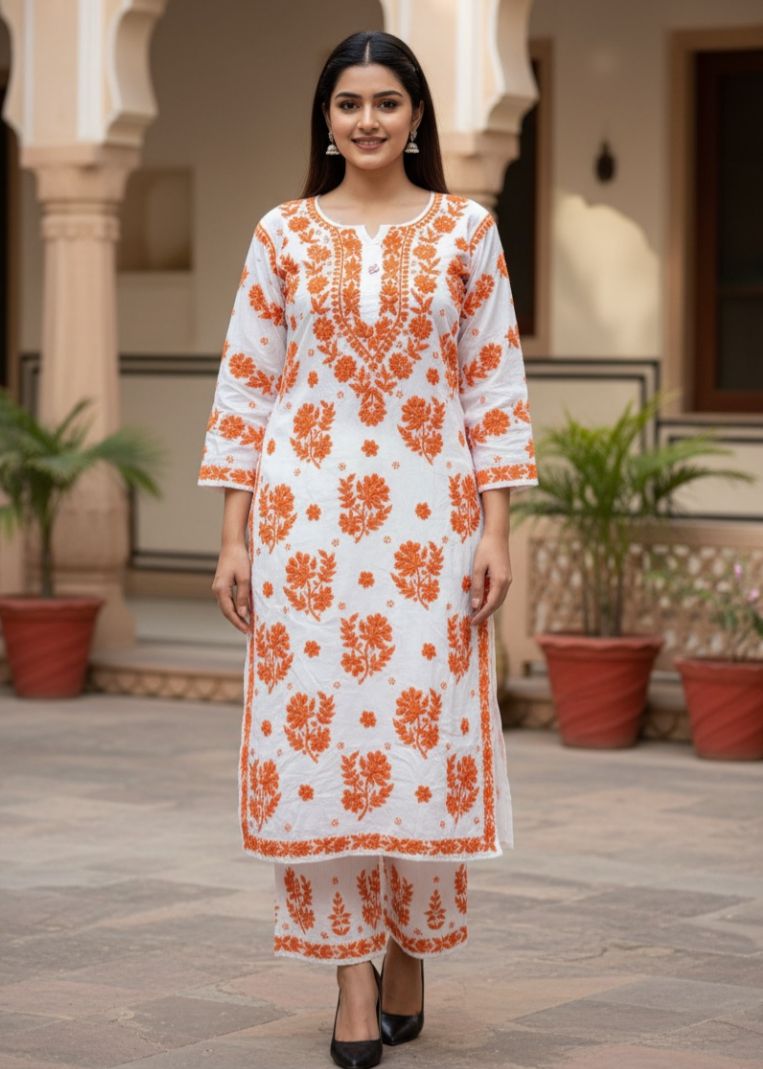
• White Cotton Chikankari Kurtis — the timeless summer essential, in mulmul and cambric
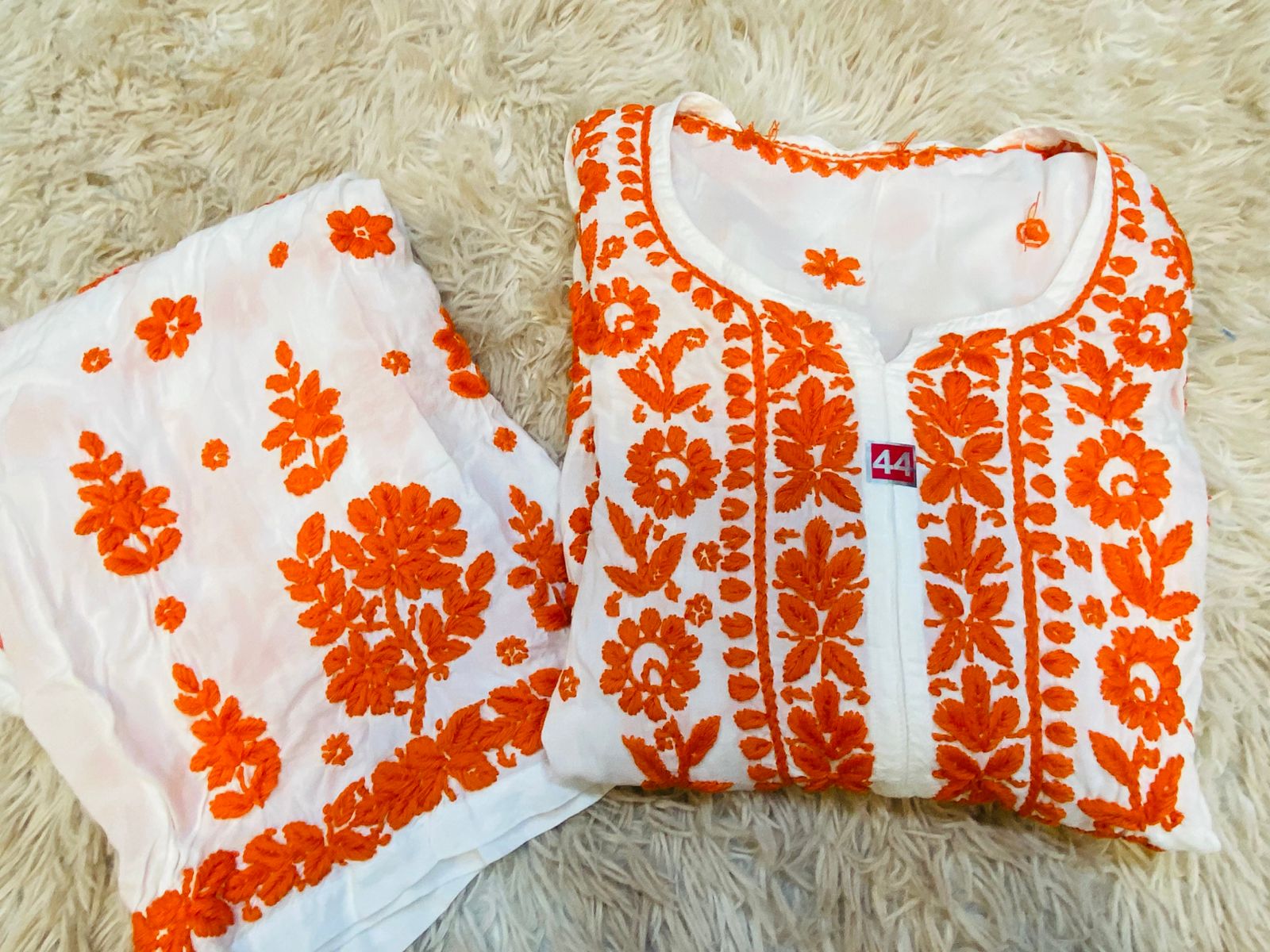
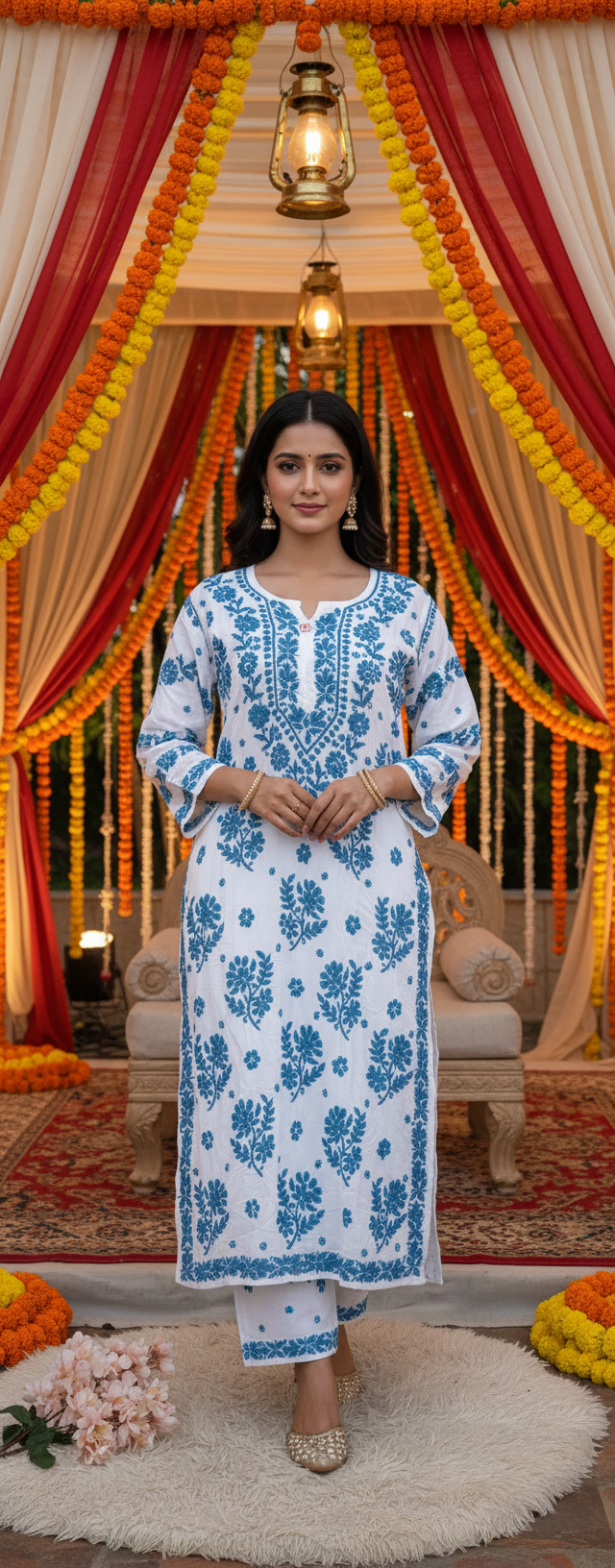
• Chikankari Kurta Sets — in pink, royal blue, red, brown, ivory — matched sets for every occasion
• Straight-Cut Chikankari Kurtis for Office — clean, professional, effortlessly Indian
• Short Chikankari Kurtis — for college, daily wear, and the modern Indian woman
• Premium Chikankari Kurta Sets — hand-embroidered festive pieces for weddings and celebrations
Free shipping across India. Easy 7-day returns. Every piece hand-embroidered in Lucknow. Every stitch, authentic.
10. Frequently Asked Questions About Chikankari
What is Chikankari embroidery?
Chikankari is a traditional Indian hand embroidery technique from Lucknow, Uttar Pradesh. It involves stitching intricate floral and geometric patterns onto fine fabric using a needle and thread — most traditionally white thread on white fabric.
Where does Chikankari come from?
Chikankari originated in Lucknow, India, approximately 400 years ago during the Mughal era. It reached its peak under the Nawabs of Awadh and is legally protected under a GI (Geographical Indication) tag — only Lucknow artisans can produce authentic Lucknow Chikankari.
Which fabric is best for Chikankari?
Mulmul (muslin cotton) is the most traditional and prized fabric for Chikankari. Pure cotton and cambric are popular for daily and office wear. Georgette and chanderi are used for festive Chikankari pieces.
How long does it take to make a Chikankari kurta?
A single hand-embroidered Chikankari kurta can take between 2 to 6 weeks to complete, depending on the density and complexity of the embroidery design. Premium pieces with dense jali or keel kangan work take longer.
How do I know if Chikankari is authentic?
Authentic Chikankari has slight pattern irregularities (no two stitches are identical), raised thread texture you can feel, shadow work visible on the reverse side of the fabric, and a price that reflects real hand labor. Machine-printed 'Chikankari' is completely flat with zero texture. All AM Chikankari pieces are 100% hand-embroidered.
How should I wash a Chikankari kurta?
Hand wash in cold water using a mild detergent. Do not wring — gently press out excess water. Dry flat in shade, away from direct sunlight. Iron on the reverse side with medium heat to protect the embroidery.