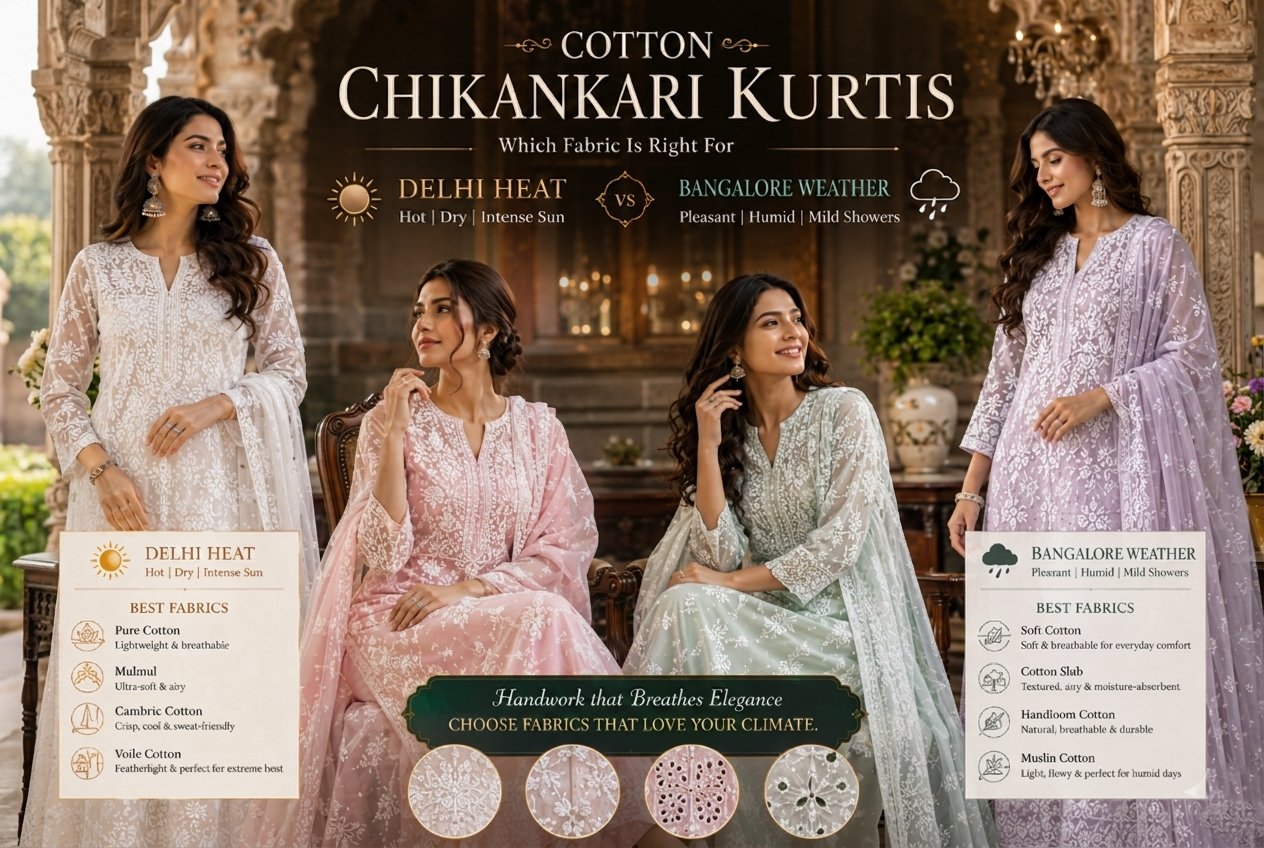
Cotton Chikankari Kurtis - Which Fabric Is Right for Delhi Heat vs Bangalore Weather
A complete, honest guide to mulmul, cotton dobby, rayon, chanderi and satin Chikankari — and why your city's climate, your daily context, and your occasion should drive your fabric choice.
TABLE OF CONTENTS
1. Why Cotton and Chikankari Are Inseparable - The Historical and Technical Case
2. The Fabric Families in AM Chikankari's Collection - What Each One Is and Does
3. City-by-City Fabric Guide - What Works Where
4. The White Chikankari Kurta - A Case Study in Fabric and Versatility
5. Building Your Cotton Chikankari Capsule - Four Pieces That Cover Everything
6. Care by Fabric Type - Quick Reference
1. Why Cotton and Chikankari Are Inseparable - The Historical and Technical Case
Chikankari was born on cotton. Not as a preference, not as a marketing position, but as a technical necessity rooted in the specific demands of the craft itself. The defining technique of Lucknow Chikankari - bakhiya shadow work, where the artisan stitches from the underside of the fabric to create shadows visible through the front - requires a base fabric fine enough to allow that shadow to show through. Cotton muslin, and particularly the extraordinarily fine weave historically called "woven air," was the only fabric in 17th-century India that met this requirement.
The same properties that made cotton the original choice for Mughal-era Chikankari embroiderers are exactly the properties that make it the right choice for Indian women in 2026. Cotton breathes in heat. It holds embroidery thread correctly without the thread slipping. It washes and dries without losing shape. And it develops a beautiful softness with age that synthetic fabrics never achieve - a quality that makes a well-cared-for cotton Chikankari kurta look more beautiful after five years than it did on the day it was bought.
India's relationship with cotton stretches over 5,000 years - longer than any other cotton-producing culture in the world. Lucknow Chikankari represents the most refined expression of that relationship. Choosing cotton Chikankari in 2026 is not nostalgia. It is the most technologically correct choice available.
"Suton mein jab hawa basi thi, tab Lucknow ne buna tha yeh noor, Mulmul ki har ret mein, chhupi hai koi poori baat zaroor." When the breeze made its home in the threads, that is when Lucknow wove this light - in every fold of mulmul, a whole story hides itself.
2. The Fabric Families in AM Chikankari's Collection - What Each One Is and Does
AM Chikankari works across multiple fabric families, each with different physical properties suited to different purposes, climates, and occasions. Understanding these differences transforms the way you buy - instead of choosing by colour alone, you begin choosing by the full picture of what you need the garment to do.
Mulmul Cotton - The Original and the Best for Indian Summers
Mulmul, known internationally as muslin, is the cloth that made Lucknow Chikankari famous. A loosely woven cotton with a thread count low enough that the finished fabric is genuinely, beautifully translucent. A full-length mulmul Chikankari kurta typically weighs between 80 and 110 grams - comparable in weight to a light scarf.
The properties of mulmul are extraordinary: it is the coolest natural fabric available anywhere in Indian ethnic wear, it allows virtually unlimited air circulation against the skin, and it displays bakhiya shadow embroidery with the luminosity that no other fabric can match. Hold a genuine mulmul Chikankari piece to natural sunlight and the shadow stitching glows through the fabric like light through water. This is the quality that made Lucknow Chikankari legendary in royal courts and European drawing rooms alike during the Mughal and Nawabi eras.
Best for Delhi - Mulmul is not just recommended for Delhi summers, it is essentially the correct answer to 45-degree April and May. No other fabric worn in that heat provides the same combination of dignity and physical comfort. A well-draped mulmul Chikankari kurta keeps you genuinely cool while looking unmistakably beautiful - something no synthetic "cool fabric" can manage.
Best for Hyderabad - Hyderabad's sustained heat and moderate humidity make mulmul the preferred choice from March through October. The open weave manages both temperature and moisture better than any synthetic or heavier cotton alternative.
Our Suhana Navy Blue Hand Chikankari Kurti in Pure Mulmul Cotton is the definitive example of what mulmul Chikankari can be - deep navy ground, full sleeves, pure mulmul that breathes through a Delhi summer day while looking composed and beautiful. The Flower Pink Mulmul Chikankari Kurti Set pairs pure mulmul with a lycra cotton pant for a complete summer set that is as comfortable as it is beautiful.
Cotton Dobby - When Texture Adds Depth to White-on-White
Cotton dobby is a figured woven cotton where the loom creates small geometric patterns in the fabric itself during weaving - giving the cotton a textured surface that is visible and tactile at close range. This is not decoration applied to the fabric. It is the fabric's own structure, created by the weaving process itself.
For Chikankari, cotton dobby adds a layer of visual interest that plain cotton lacks without changing the fundamental properties that make cotton ideal for the embroidery. The textured weave gives white cotton a subtle depth - you see the fabric and the embroidery together as layers rather than as flat surface and applied pattern. The result, particularly in white, is a piece that rewards attention in ways that simpler cotton bases do not.
The Saiyaara White Cotton Dobby Chikankari Kurti - our most refined everyday piece - demonstrates this quality beautifully. At close range, the interplay of the dobby texture and the hand Chikankari embroidery creates a visual complexity that is immediately distinguished from printed or plain-base alternatives. The handmade crochet button at the neckline adds a further layer of artisan detail that makes this piece feel genuinely considered.
Mulmul Printed Chikankari - When Block Print Meets Hand Embroidery
Some of AM Chikankari's most practical summer sets combine two craft traditions: block printing, where traditional carved wooden blocks are pressed against the fabric with natural dye to create a printed pattern, and hand Chikankari embroidery applied on top of the printed base. The two crafts coexist in interesting visual dialogue - the boldness of the print providing a base layer that the delicacy of the Chikankari threadwork refines and elevates.
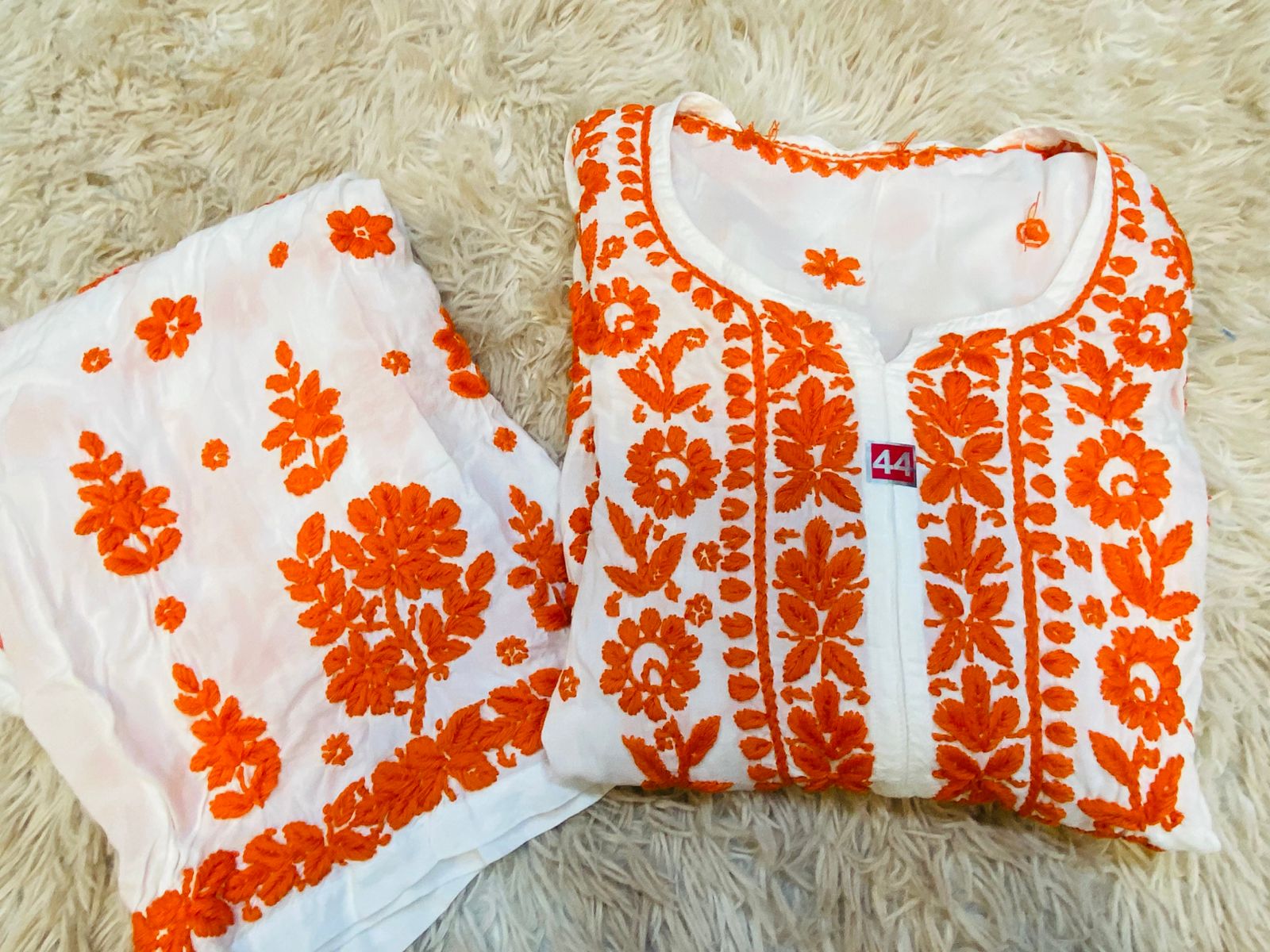
The Netra Yellow Printed Mulmul Chikankari Kurti Set, the Netra Blue, and the Netra Lavender all use this combination on pure mulmul cotton, paired with a free-size pant that fits waist measurements up to 44 inches. The free-size pant is genuinely practical for gifting - it solves the most common obstacle in ethnic wear gifting, which is size uncertainty on the bottom. The mulmul fabric keeps the set cool through India's summer months.
Heavy Modal Rayon - Structure, Drape and Colour Depth
Heavy modal rayon has more structure and drape than standard rayon - it holds its silhouette through a full day at a wedding or festival without wrinkling. For three-piece sets - kurti, palazzo, dupatta - where the garment needs to maintain its shape through hours of wear, heavy modal rayon performs significantly better than lighter alternatives. The fabric takes dye exceptionally well, producing deep, saturated colours that hold through washing in a way that cheaper rayon alternatives cannot match.
AM Chikankari's Gunjan range uses heavy modal rayon for exactly this reason. The Gunjan Purple 3-Piece Hand Chikankari Rayon Set with Palazzo and Dupatta, the Gunjan Red, and the Gunjan Blue represent the full-day festive set at its most practical and most beautiful. A 46-inch kurti, 39-inch palazzo, and flowing chiffon dupatta - all in coordinated colour and embroidery. The heavy modal holds the drape from first wearing to end of a long celebration evening.
Pure Rayon Cotton - The Everyday Straight Kurti Fabric
Soft rayon cotton is lightweight, breathable, and comfortable - the right fabric for the kurta you reach for every other day. It does not have the structural weight of modal rayon, which makes it more casual and more comfortable for daily wear. The straight-cut silhouette works exceptionally well in rayon cotton because the slight softness of the fabric allows it to drape with natural ease rather than holding a stiff architectural line.
AM Chikankari's Anaya range is built on soft rayon cotton in a straight-cut silhouette - the most wearable, most versatile format in our collection. The Anaya Pink Hand Chikankari Straight Kurti, the Anaya White, and the Anaya Lavender offer 46-inch straight-cut Chikankari kurtis that work equally well for daily wear, office, and casual festive occasions. The Anaya range is the most accessible authentic Chikankari in our collection - hand-embroidered, natural fabric, honest pricing.
Chanderi - When You Need Natural Lustre for Celebrations
Chanderi is a fabric with a 600-year history from Chanderi, Madhya Pradesh - traditionally woven using a combination of cotton and silk that creates a natural lustre you cannot achieve with pure cotton. The fabric catches light in a way that elevates its visual register from everyday to celebratory, while retaining enough cotton content to breathe and drape naturally. It is not as heavy as pure silk, not as ordinary as plain cotton - it occupies the refined middle ground that festive occasions require.
Chikankari embroidery on chanderi is technically more demanding than on regular cotton - the fine, slightly slippery surface of chanderi requires greater artisan precision to maintain stitch tension and placement. This is skilled work at a higher tier than everyday cotton embroidery, and it shows in the finished piece.
AM Chikankari's Chanderi range covers all the key festive colours: Chanderi White, Chanderi Pink, Chanderi Red, Chanderi Blue, Chanderi Purple, and Chanderi Green. Each set pairs a 46-inch chanderi kurta with a 39-inch palazzo and a pure cotton inner lining that prevents the slightly sheer chanderi from being see-through while maintaining full comfort. These are the sets for occasions worth dressing for.
Premium Satin - For the Highest Visual Impact
Satin's high-gloss surface amplifies colour depth in a way that matte fabrics cannot. The same shade of orange on cotton versus satin looks entirely different - on satin, it glows, catches light from multiple angles, and creates a visual impact that reads as premium and celebratory at a distance. For 3D raised embroidery - our most technically demanding work - satin is the ideal base because the raised thread elements catch satin's natural reflective quality and appear sculptural in a way that flat fabric does not allow.
AM Chikankari's Aira range uses premium satin as the base for our 3D handwork Chikankari sets - Aira Orange, Aira Blue, Aira Purple, and Aira Brown. The combination of satin's natural sheen and the raised sculptural embroidery creates the highest visual impact in our collection. These are the pieces for Diwali evenings, sangeet nights, and any occasion where arriving in something unmistakably beautiful is the point.
3. City-by-City Fabric Guide - What Works Where
Delhi - Mulmul First, Always
Delhi's extreme temperature range - from 45 degrees in summer to 5 degrees in winter - means the fabric question changes by season. For April through September: mulmul cotton is the only rational answer. It is the only fabric that keeps you genuinely cool at 42 degrees while looking elegant. No synthetic "breathable" fabric performs the way mulmul does in genuine North Indian summer heat.
For October through February: rayon cotton and modal rayon transition well as temperatures drop. Chanderi and satin become appropriate for Delhi's festival-heavy autumn and winter calendar - Dussehra, Diwali, and the wedding season all fall within this period.
Mumbai - Rayon Cotton and Chanderi for Year-Round Versatility
Mumbai's famously consistent climate - humid and warm year-round, never as extreme as Delhi's summer peak - means fabric choice is less about seasonal temperature and more about occasion and professional context. Soft rayon cotton is Mumbai's everyday Chikankari fabric - comfortable, draping, easy to maintain through a long day in the city. Chanderi is Mumbai's festive fabric - appropriate for the city's sophisticated social calendar without being too heavy for the climate.
Mumbai commute culture also argues for rayon over mulmul in daily wear - rayon holds up to the physical demands of the city better than delicate mulmul. Save the mulmul pieces for quieter days and home occasions where the delicacy of the fabric is appropriate.
Hyderabad - Mulmul for Summer, Chanderi for Celebrations
Hyderabad's two seasons - hot and very hot - make mulmul the default fabric choice for the majority of the year. Hyderabad temperatures regularly exceed 40 degrees from March through June, and the humidity from July through September makes lightweight fabrics practically important rather than just aesthetically preferred.
For Hyderabad's significant festival calendar - Eid, Bonalu, Bathukamma, Navratri - chanderi and satin Chikankari sets are the appropriate celebratory choices. The city's strong craft appreciation culture means that genuine quality in chanderi - the natural lustre of the fabric, the precision of the embroidery - will be noticed and appreciated.
Bangalore - Cotton Dobby and Rayon Year-Round
Bangalore's uniquely temperate climate means the fabric question is less urgent than in other Tier 1 cities. The city rarely gets hot enough to require mulmul for survival comfort, and rarely gets cold enough to require heavy fabric for warmth. Cotton dobby and soft rayon cotton work year-round in Bangalore - comfortable, appropriate, versatile.
For Bangalore's tech and startup culture - where professional dress codes are often casual-formal hybrids - a straight-cut rayon Chikankari kurti like the Anaya range sits perfectly between traditional and contemporary. It is cultural without being ceremonial, ethnic without being formal. The exact register Bangalore's professional culture most naturally occupies.
4. The White Chikankari Kurta - A Case Study in Fabric and Versatility
The white cotton Chikankari kurta deserves particular examination because it is the most versatile single piece of ethnic wear an Indian woman can own. Its endurance through every fashion cycle is not accidental - it is the logical consequence of a garment that does everything simultaneously right.
White-on-white embroidery - thread colour matching the base fabric - is the format that shows Chikankari at its purest and most beautiful. With no colour contrast competing for visual attention, the embroidery becomes the entire subject: the texture of the knots, the flowing paths of the stitches, the luminous glow of the shadow work. This is Chikankari in its original, most authentic form.
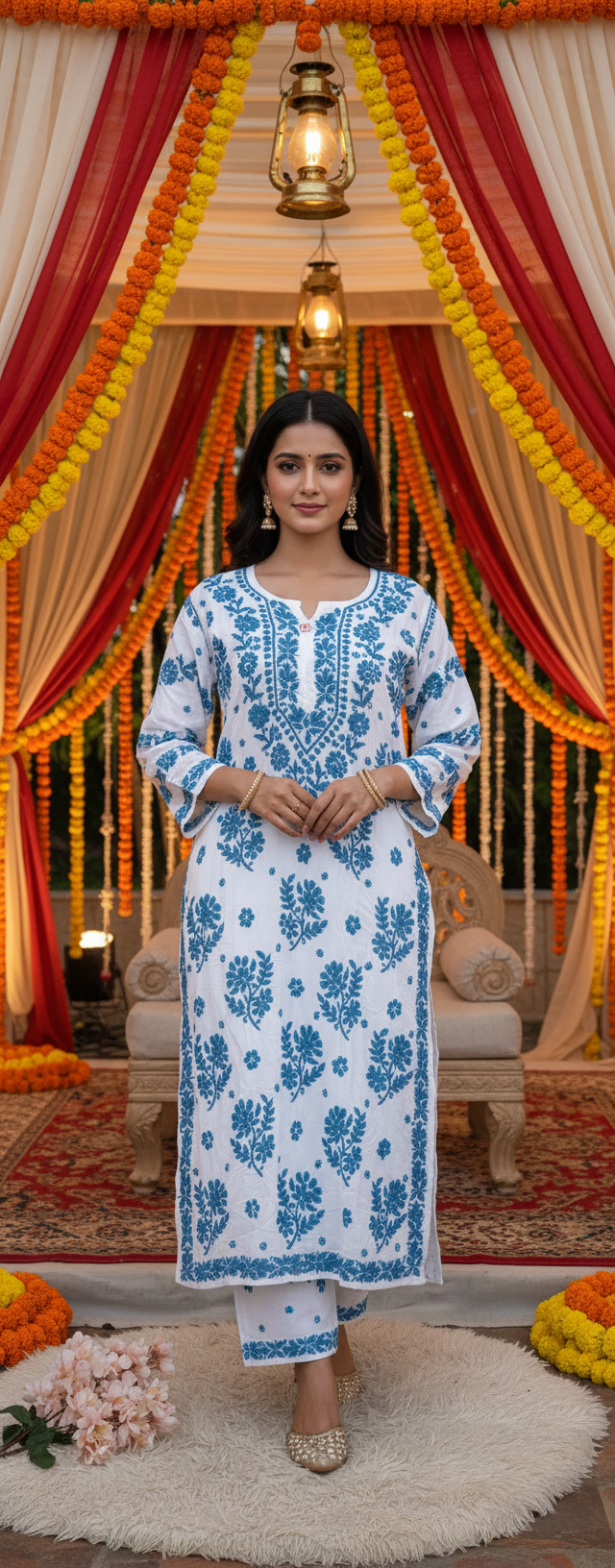
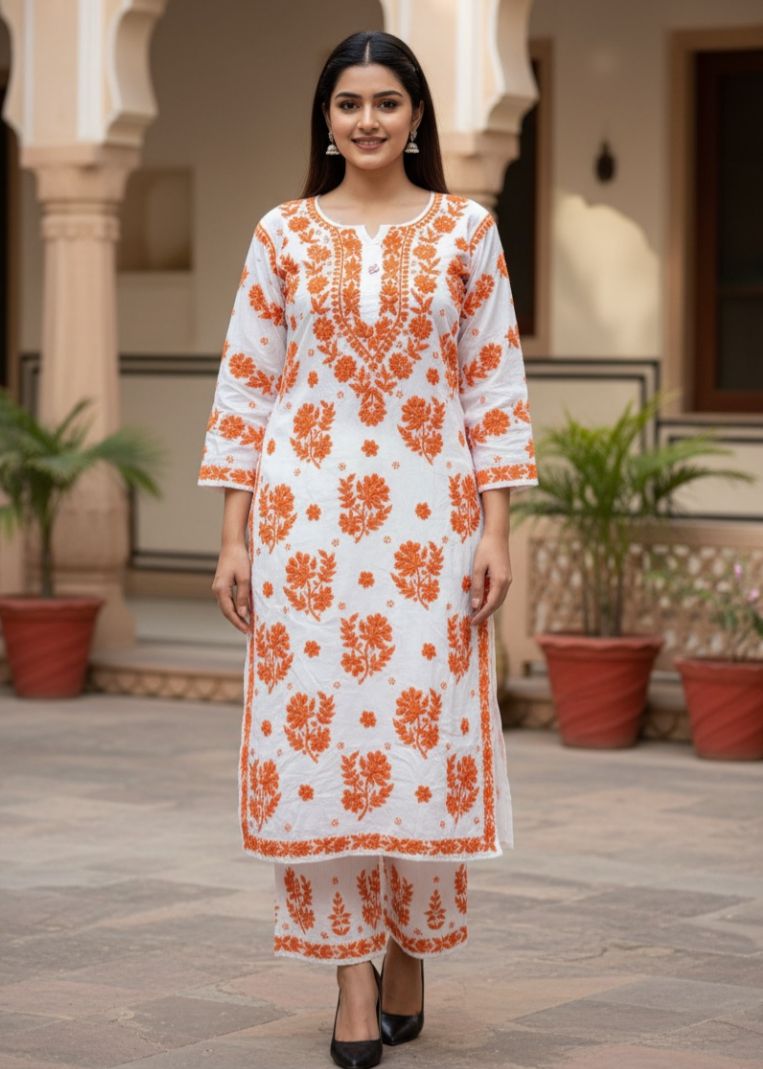
In practical terms, a white Chikankari kurta moves between contexts that almost nothing else manages. With white palazzo - a monochrome summer statement of quiet confidence. With deep indigo jeans - casual-chic that reads as deliberately stylish. With heavy gold jhumkas - festive without effort. With straight trousers and a leather bag - professional ethnic wear of genuine distinction.
The fabric choice within white matters. For summers, the pure mulmul gives you the traditional luminosity and absolute maximum breathability. For everyday professional wear, the cotton dobby gives you textured depth that rewards attention. For the most premium statement, the white heavy modal with 3D thread embroidery is in a category of its own - the most technically demanding piece in the collection, on the most structured and premium base.
5. Building Your Cotton Chikankari Capsule - Four Pieces That Cover Everything
The concept of a capsule wardrobe works particularly well for Chikankari because the pieces combine freely across occasions. Here is a four-piece AM Chikankari capsule that covers every situation in a working Indian woman's calendar:
Piece 1 - White mulmul straight kurta - Your summer and Eid essential, the most versatile piece in any ethnic wardrobe. Pairs with everything. Works in every context. Lasts a decade with proper care.
Piece 2 - Chanderi or rayon kurta set in a professional colour - Deep blue, teal, or ivory. For office semi-formal, client meetings, and the range of occasions where looking put-together matters. The Chanderi Blue Chikankari Kurti Set or the Gunjan Blue Rayon 3-Piece Set both work here.
Piece 3 - Short rayon Chikankari kurti in a vibrant colour - For college, daily casual, and the occasions that need a fresh, contemporary energy. The Anaya Pink or Anaya Lavender work here perfectly.
Piece 4 - Satin or chanderi set in a deep festive colour - For Diwali, weddings, and celebrations where looking beautiful is the entire point. The Aira Purple Satin 3D Set or Chanderi Red Set cover this completely.
Four pieces. Every occasion in the Indian calendar. All hand-embroidered, all natural fabric, all made by women artisans in Lucknow. This is a wardrobe built on real value - not on trend-chasing, not on fast fashion volume, but on pieces that do what they promise and last the way natural fabric and genuine craft always does.
6. Care by Fabric Type - Quick Reference
Mulmul Cotton Care
Always hand wash in cold water. Mulmul's loosely woven structure is vulnerable to machine agitation. Dry flat in shade. A light touch of rice starch or regular starch before ironing restores the body that mulmul loses through washing - this is the traditional practice and it works. Iron on the reverse at low-medium heat.
Cotton Dobby and Rayon Care
Gentle machine wash in a mesh bag is acceptable for rayon pieces if hand washing is not possible. Cold water only. Dry hanging is fine. Iron on the right side at medium heat. Cotton dobby benefits from the same gentle treatment as mulmul - cold water, shade dry, reverse iron.
Chanderi and Satin Care
Treat chanderi as you would mulmul - cold water hand wash, flat shade dry. The silk content in chanderi requires gentle handling to prevent fibre damage. Satin pieces should be hand washed gently - the satin weave surface can catch if agitated in a machine. Iron satin on the reverse at low heat only to prevent the surface sheen from flattening permanently.
Every AM Chikankari piece comes with specific care instructions based on its fabric and embroidery type. Follow them. The difference between a Chikankari piece that lasts three years and one that lasts a decade is almost entirely in how it is washed and stored.
Browse the full AM Chikankari fabric range at amchikankari.com - mulmul, cotton dobby, rayon, chanderi, satin - all hand-embroidered, all authentic, all made to last.