Chikankari Embroidery - The Complete Guide to Lucknow's Greatest Craft
The 36+ named stitches, the process from design to finished garment, and everything you need to understand what makes a hand-embroidered Lucknowi chikankari kurta set with dupatta unlike any other textile product in the world.
|
“Ek suyi, ek dhaga, ek haath ki mehnat - yahi Lucknow ki asli daulat”
|
|
TABLE OF CONTENTS
|
|
1. What Is Chikankari Embroidery - 400 Years in One Thread
|
|
2. Why the Embroidery Makes a Lucknowi Chikankari Kurta Set Irreplaceable
|
|
3. Bakhiya - The Shadow Stitch That Cannot Be Printed
|
|
4. Tepchi, Murri, Phanda - The Foundation Stitches
|
|
5. Keel Kangan - The 3D Raised Technique
|
|
6. How a Hand-Embroidered Chikankari Kurta Set Is Made
|
|
7. Reading Embroidery Quality - What to Look For
|
|
8. Frequently Asked Questions
|
1. What Is Chikankari Embroidery - 400 Years in One Thread
Chikankari embroidery is a form of hand embroidery from Lucknow, Uttar Pradesh, developed under Mughal patronage in the early 17th century and refined across four centuries into one of the most technically complex embroidery traditions in the world. It is produced almost entirely by women artisans - an estimated 250,000 in and around Lucknow - and is protected by Geographical Indication Tag Number 44.
The word comes from the Persian chikin - a type of fine embroidery. Every hand-embroidered Lucknowi chikankari kurta set with dupatta produced today carries that four-century lineage. The artisans who embroider it learned the craft from their mothers, who learned from theirs. The stitches have not changed. The techniques have not been simplified. What has changed is the fabric range and the colour palette - the core hand embroidery of every Lucknowi chikankari kurta set with dupatta from AM Chikankari uses the same named stitches, same cotton thread, same block-printed pattern transfer that the craft used under Nawabi patronage.
2. Why the Embroidery Makes a Lucknowi Chikankari Kurta Set Irreplaceable
Most embroidered garments in the Indian market are machine-embroidered or machine-printed. Chikankari is the outlier - the craft category that genuinely requires human hands and cannot be faithfully replicated by any machine process currently available. The bakhiya shadow stitch, the murri and phanda knot textures, the keel kangan raised 3D work - none of these are technically achievable at quality by machine. This is why a 100% authentic Lucknowi chikankari kurta set is not interchangeable with a machine-made alternative regardless of how similar they look in a product photograph at standard scale.
When you invest in a hand-embroidered chikankari kurta set with dupatta from AM Chikankari, you are investing in work that cannot be outsourced, cannot be automated, and cannot be replicated at a price point below what genuine artisan labour costs. The hand-embroidered Lucknowi chikankari kurta set is the most honest product in Indian ethnic wear - it is exactly what it says it is and nothing else.
3. Bakhiya - The Shadow Stitch That Cannot Be Printed
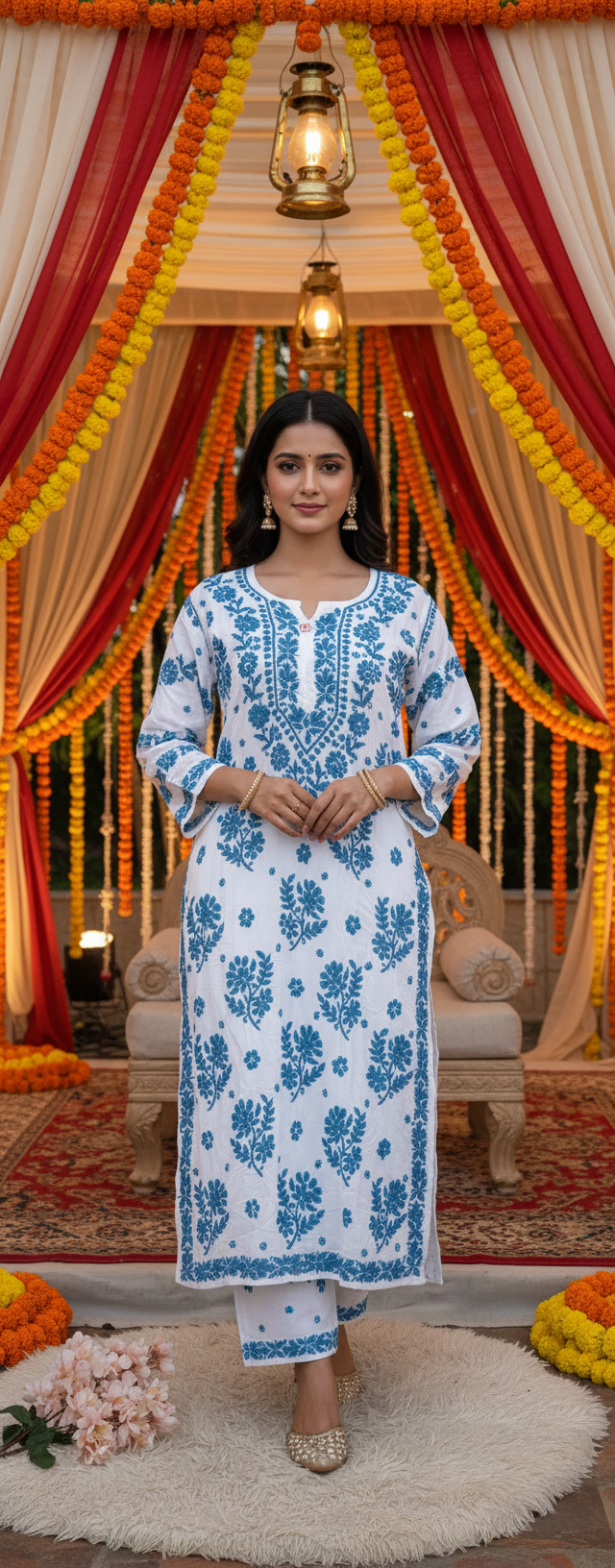
Bakhiya is worked entirely from the underside of the fabric. The artisan looks at the back, stitches through to the front, and creates a shadow visible through fine cotton from the right side. When you hold a genuine hand-embroidered Lucknowi chikankari piece - particularly mulmul or fine cotton like the Suhana Navy Blue Pure Mulmul Chikankari Kurti - to natural daylight, flowers and leaves appear to float inside the fabric, backlit by a soft luminosity. No inkjet printer, no digital embroidery machine, no sublimation process can replicate this effect. The shadow is created by the physical structure of thread in fabric, worked from the reverse. It requires a human hand. This technique alone makes every white rayon hand-embroidered Lucknowi chikankari kurta set with dupatta from AM Chikankari fundamentally different from any machine-made alternative.
4. Tepchi, Murri, Phanda - The Foundation Stitches
Tepchi - The Long Running Stitch
Tepchi is the foundation running stitch that creates the structural backbone of most Lucknowi chikankari designs. It travels in long, controlled passes creating the flowing outlines and filled areas that give every hand-embroidered chikankari kurta set its organic, natural quality. Mastering tepchi - consistent tension and length at working speed - takes months of daily practice.
Murri and Phanda - The Knot Texture Stitches
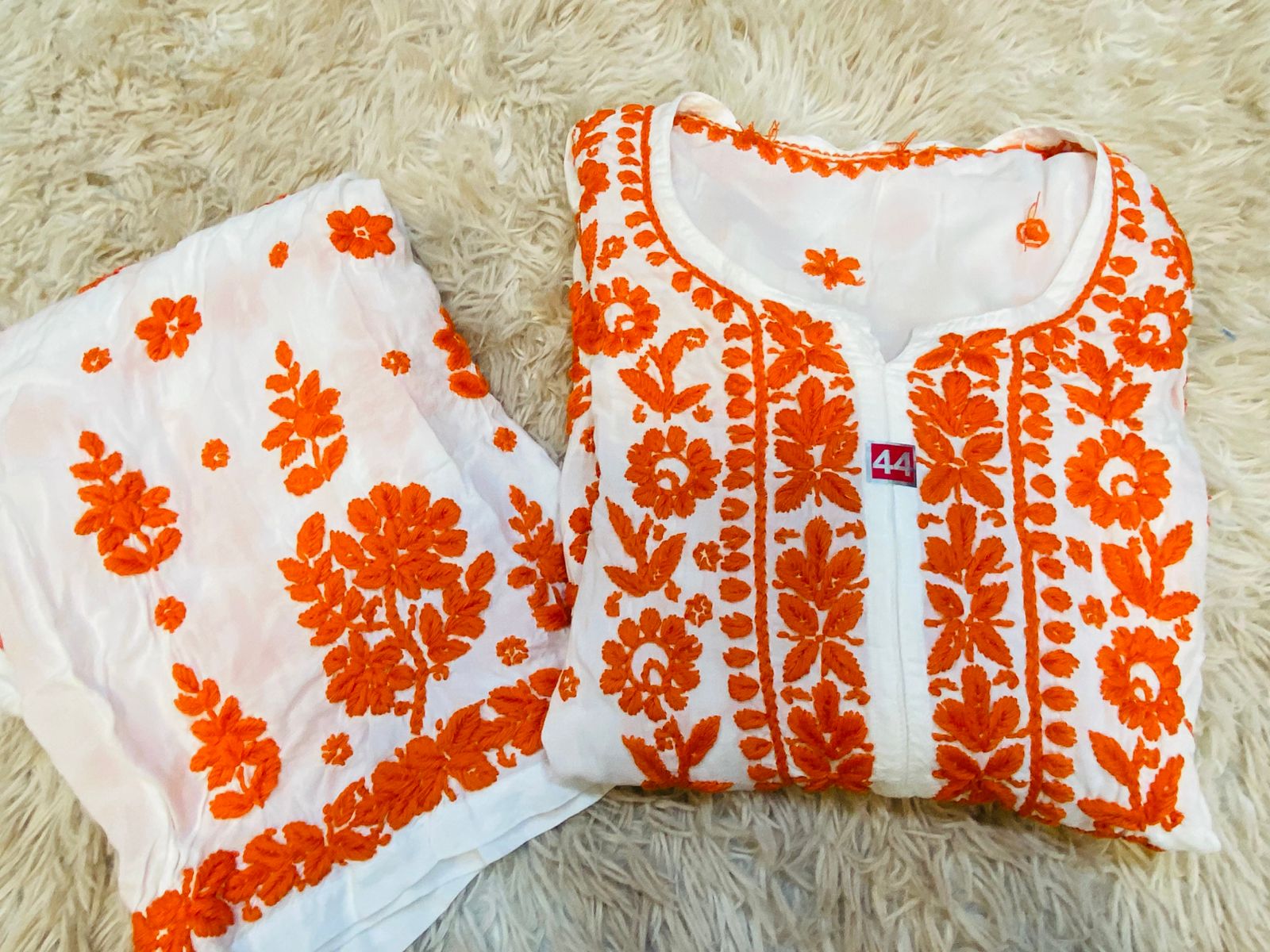
Murri are rice-grain-shaped knots built in clusters to create depth within floral motifs. Phanda are smaller still. A single floral motif in a quality Lucknowi chikankari piece may contain five hundred or more individual murri and phanda knots. Run your finger across the embroidery on the Sneha White Heavy Modal 3D Chikankari Kurta Set and you feel each raised element distinctly. This physical texture is the most immediate sensory proof that you are holding a hand-embroidered chikankari kurta set with dupatta rather than a machine-made alternative.
5. Keel Kangan - The 3D Raised Technique
Keel kangan creates raised, three-dimensional embroidery by building multiple thread passes on the fabric surface - layer by layer - until the motif has genuine sculptural height. The Sneha White Heavy Modal Chikankari Kurta Set with 3D Cotton Thread Embroidery is AM Chikankari's most technically accomplished piece - keel kangan raised work on heavy modal that gives the hand-embroidered Lucknowi chikankari kurta set a sculptural quality visible from across a room and immediately tactile in the hand. This is the technique that most clearly differentiates the finest 100% authentic Lucknowi chikankari kurta sets from everything else available through Lucknow chikankari kurti set online shopping.
6. How a Hand-Embroidered Chikankari Kurta Set Is Made
Step 1 - Block Printing the Pattern
Every Lucknowi chikankari kurta set begins with a block printer pressing a carved wooden block against the fabric with washable ink. The block-printed outline is the embroidery guide. After embroidery is complete, washing removes the printed lines and leaves only the hand embroidery. The blocks are themselves skilled craftsmanship - traditional chikankari design blocks carved from sheesham wood by specialist craftspeople.
Step 2 - The Embroidery Process
The fabric passes through the hands of one or more artisan specialists. A 100% authentic Lucknowi chikankari kurta set typically involves multiple artisans - one for foundation tepchi work, another for bakhiya shadow stitching, a third for murri and phanda texture. For premium 3D sets like the Sneha White Modal, additional specialist time goes into keel kangan raised embroidery. This specialisation is how each artisan develops exceptional skill in her specific technique area.
Step 3 - Washing and Finishing
After embroidery, the piece is washed to dissolve the block-printed guidelines, leaving only the hand embroidery visible. Then pressed, inspected, and finished. The washing step is why cotton and mulmul were historically preferred - their open weave allows thorough washing without damaging the delicate shadow stitching. Every white rayon hand-embroidered Lucknowi chikankari kurta set with dupatta goes through this full process before it reaches you.
7. Reading Embroidery Quality - What to Look For
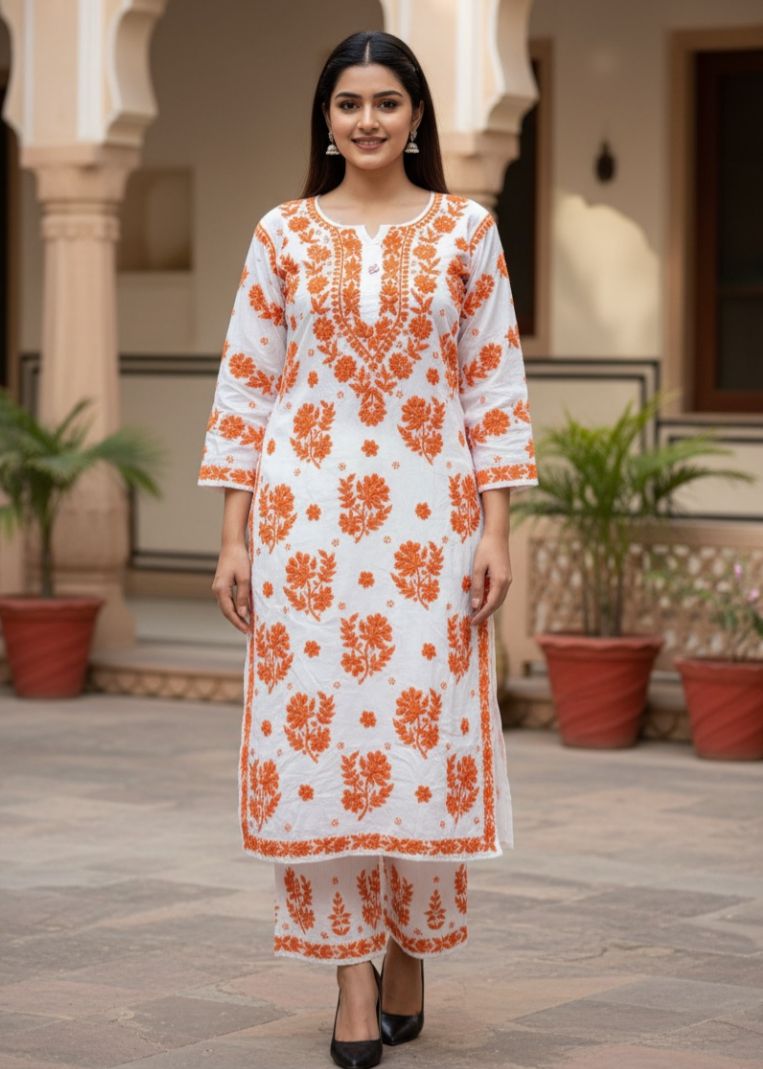
Embroidery density: how many stitches per square centimetre. Higher density reflects more artisan time and richer visual texture. Stitch consistency: how even and controlled the stitching is across the full garment. Motif complexity: how many distinct stitch types appear in each design element. Coverage: whether embroidery runs across the full kurta or concentrates only at the most visible points. AM Chikankari's Saiyaara White Cotton Dobby Kurti demonstrates quality at an accessible level. The Gunjan White Rayon Hand-Embroidered Lucknowi Chikankari Kurta Set with Dupatta shows it in complete 3-piece format. The Sneha 3D Modal Set represents the top of the quality range. Three pieces, three quality tiers, all 100% authentic Lucknowi chikankari from hand embroidery chikankari kurti online shopping at amchikankari.com.
8. Frequently Asked Questions
1. How many types of stitches does authentic Lucknowi chikankari embroidery use?
Over 36 distinct, named hand-embroidery stitches. The most important are bakhiya (shadow stitch from reverse - uniquely Lucknowi and irreproducible by machine), tepchi (foundation running stitch), murri and phanda (knot texture stitches), keel kangan (3D raised technique), zanjeera (fine chain stitch), and ghas patti (grass stitch). A hand-embroidered Lucknowi chikankari kurta set with dupatta of moderate quality uses eight to twelve of these stitches in coordinated combination.
2. What is 3D chikankari embroidery?
3D chikankari embroidery uses the keel kangan technique - thread built up in multiple layers on fabric surface until motifs have genuine physical height you can see and feel. The Sneha White Heavy Modal Chikankari Kurta Set from AM Chikankari uses 3D cotton thread embroidery. This technique requires significantly more artisan time than flat embroidery and represents the highest technical level in 100% authentic Lucknowi chikankari kurta sets.
3. How long does a hand-embroidered Lucknowi chikankari kurta set take to make?
A moderately embroidered hand-embroidered chikankari kurta set with dupatta takes two to four artisan days. A densely embroidered complete set takes four to eight days. A premium 3D embroidery set with keel kangan raised work takes eight to twelve days across multiple specialist artisans. This timeline directly explains why 100% authentic Lucknowi chikankari kurta sets are priced higher than machine alternatives - every hour is real.
4. Can I tell if a chikankari embroidery is hand-done by touching it?
Yes - in most cases immediately. Run your finger across murri knot stitch areas. Genuine hand chikankari has distinct, raised knots you can feel individually. Across flat machine-printed alternatives, you feel nothing. For keel kangan 3D work, the height and variation of the raised embroidery is immediately obvious to any hand that touches the Sneha White 3D Modal Set versus any machine alternative.