Authentic Chikankari Kurti - 7 Tests That Separate Real Lucknowi Craft from Imitation
Everything a buyer needs to know before paying for authentic Lucknowi chikankari - because between 60 and 80 percent of what is labelled chikankari online is not.
|
“Nakli ki chamak pe mat jao - asli chikankari ki pehchan, aankhon ko gehri nazar chahiye”
|
|
TABLE OF CONTENTS
|
|
1. Why Authentic Chikankari Is So Hard to Find Online
|
|
2. Test 1 - The Reverse Fabric Test
|
|
3. Test 2 - The Bakhiya Shadow Test
|
|
4. Test 3 - The Texture and Knot Test
|
|
5. Test 4 - The Uniformity Test
|
|
6. Test 5 - The Thread and Fabric Test
|
|
7. Test 6 - The Price Logic Test
|
|
8. Test 7 - The Supply Chain Test
|
|
9. AM Chikankari's Authenticity Promise
|
|
10. Frequently Asked Questions
|
1. Why Authentic Chikankari Is So Hard to Find Online
In 2026, between 60 and 80 percent of what is sold online as chikankari is not genuine hand-embroidered work. Machine-printed polyester sold as 'Lucknowi hand chikankari.' Machine-embroidered fabric listed as '100% authentic Lucknowi chikankari kurta set.' Digital embroidery on synthetic fabric priced like an authentic Lucknowi chikankari kurta set from GI-protected artisans. The scale of this deception is systematic and relies on one fact: most buyers cannot distinguish genuine hand embroidery from machine alternatives in a small product photograph.
But the tests exist. All of them are simple. None requires specialist knowledge. After reading this guide, you will be able to evaluate any chikankari listing - including a white rayon hand-embroidered Lucknowi chikankari kurta set with dupatta from any brand - with confidence. The difference between a 100% authentic Lucknowi chikankari kurta set and its imitation is not subtle once you know what you are looking for.
2. Test 1 - The Reverse Fabric Test (Most Reliable)
Turn the garment over and examine the back of the embroidery area. On a genuine 100% authentic Lucknowi chikankari kurta set with dupatta - particularly the bakhiya shadow work - you see deliberate, careful stitching on the reverse with thread ends and natural tension variation. The back looks exactly like the functional reverse of careful hand stitching because that is what it is. On machine-embroidered pieces, the reverse shows a mechanical locking stitch or a stabiliser - a stiff interfacing material used to prevent machine embroidery from puckering fabric. Stabiliser on the back means machine-made. Request reverse photographs for any hand-embroidered chikankari kurta set with dupatta before purchasing online.
3. Test 2 - The Bakhiya Shadow Test (Uniquely Diagnostic)
Hold the piece - particularly fine cotton or mulmul - to natural daylight. Genuine bakhiya shadow work creates a luminous effect visible through the fabric from the front: flowers and leaves appearing to float inside the cloth, backlit from within. This is physically impossible to replicate with any printing or machine-embroidery technology. The Suhana Navy Blue Pure Mulmul Chikankari Kurti demonstrates bakhiya shadow at maximum contrast - dark navy ground making the shadow detail dramatically visible in daylight. The Saiyaara White Cotton Dobby Chikankari Kurti shows the same effect on white cotton - the floating flowers visible when held against window light. No piece claiming to be a 100% authentic Lucknowi chikankari kurta set should lack this effect in its fine cotton or mulmul pieces.
4. Test 3 - The Texture and Knot Test
Run your finger across the embroidered area of any hand-embroidered chikankari kurta set with dupatta. Genuine Lucknowi chikankari has physical, tactile dimension: murri and phanda knot stitches create individual raised points you feel distinctly under the fingertip. Keel kangan raised work has genuine sculptural height. The Sneha White Heavy Modal Chikankari Kurta Set with 3D Embroidery is the most extreme version of this - 3D raised embroidery that is immediately obvious to any hand that touches it. Machine-printed chikankari is completely flat. Machine embroidery may have minimal texture but it is mechanically uniform, not organically varied.
5. Test 4 - The Uniformity Test
Examine adjacent repeated embroidery motifs on any chikankari kurta set with dupatta at maximum zoom. Genuine hand embroidery on a 100% authentic Lucknowi chikankari kurta set has natural, subtle variation between repetitions - one petal fractionally longer, spacing varying by a millimetre. This inconsistency is evidence of human hands. Machine embroidery repeats with mechanical perfection. If every motif across the white rayon chikankari kurta set you are considering looks mechanically identical at close inspection, the piece was made by a machine regardless of its label.
6. Test 5 - The Thread and Fabric Test
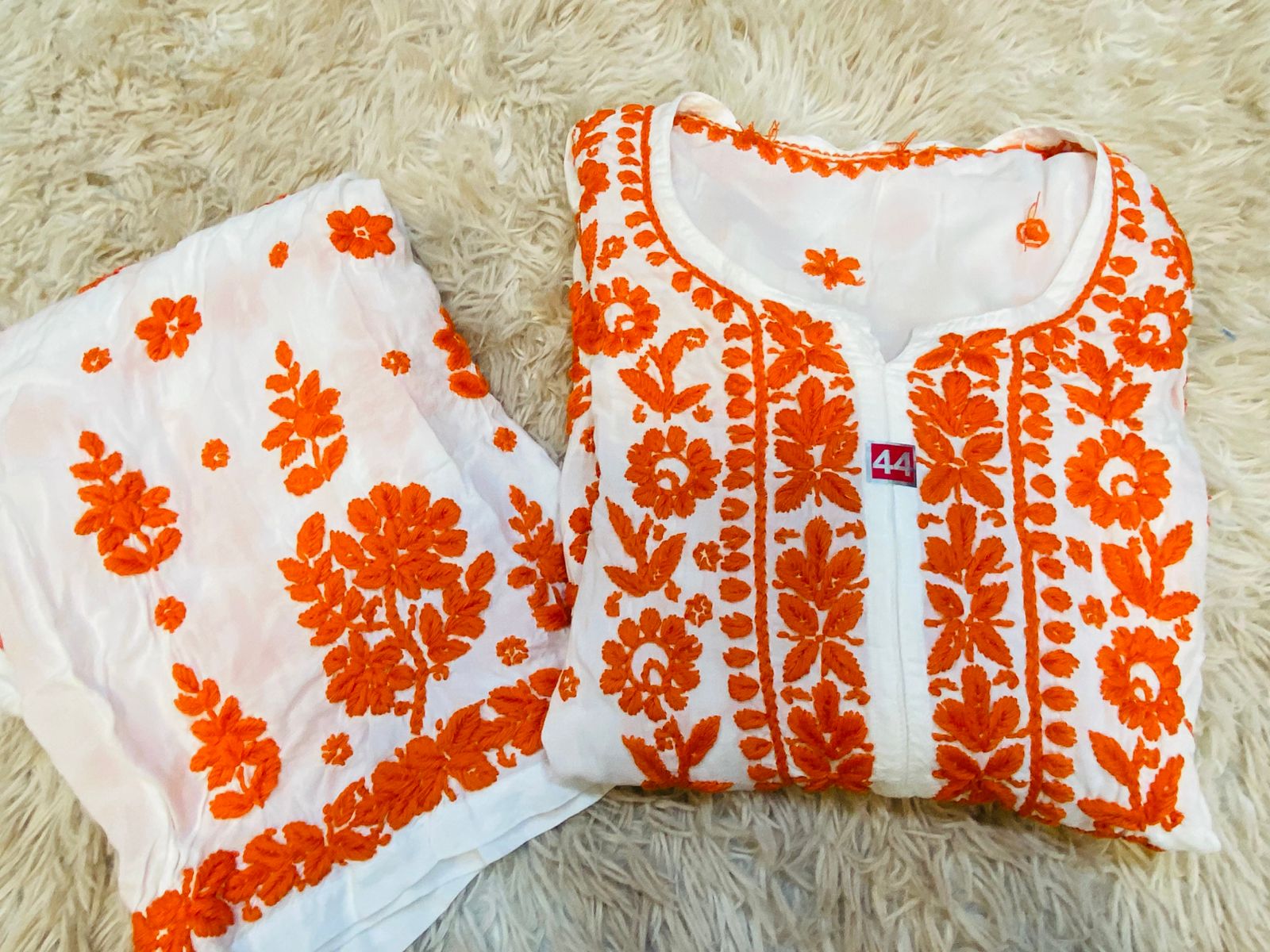
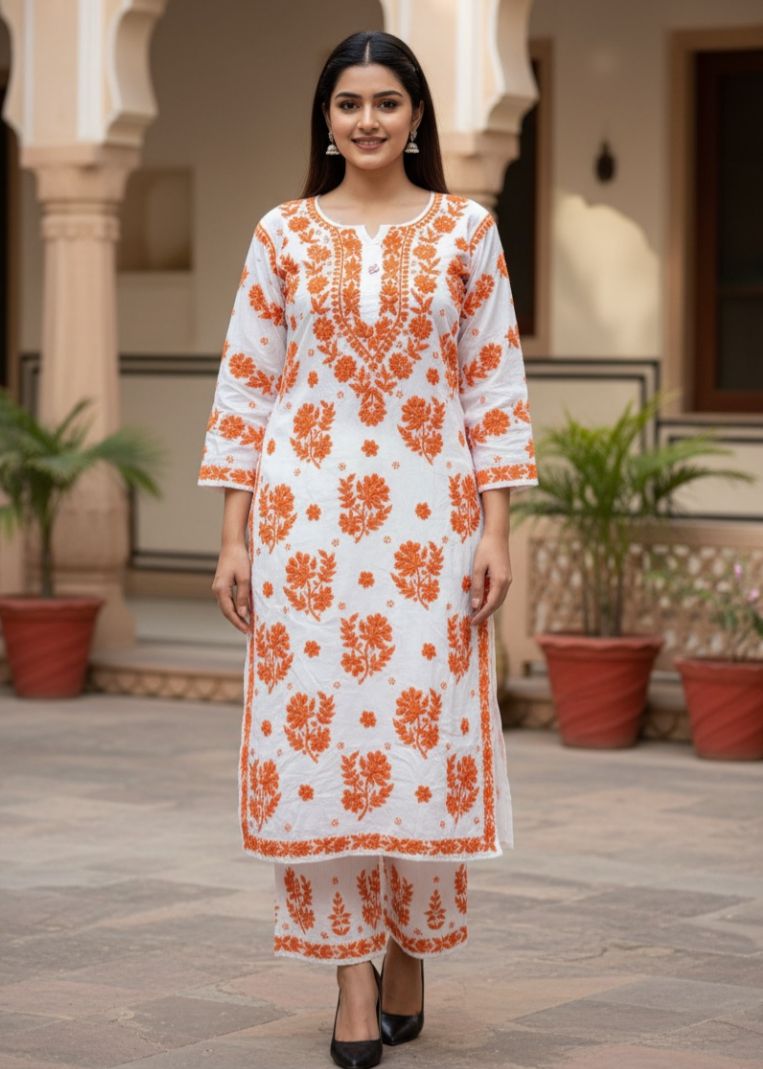
Traditional Lucknowi hand chikankari uses white cotton thread on natural fabric grounds - cotton, mulmul, modal, chanderi. If a piece claims to be a hand-embroidered chikankari kurta set with dupatta but uses polyester fabric or heavily coloured thread work throughout its body, it is not traditional Lucknowi chikankari. Rayon is an acceptable modern fabric for the Lucknowi chikankari kurta set format - the Gunjan White Rayon Hand-Embroidered Lucknowi Chikankari Kurta Set with Dupatta uses heavyweight rayon that drapes well and accepts hand embroidery cleanly. Polyester is not.
7. Test 6 - The Price Logic Test
A 100% authentic Lucknowi chikankari kurta set with dupatta requires real artisan hours. A complete rayon set: two to four days. A dense 3D modal set: eight to twelve days. At any living wage for Lucknow's skilled artisans, this labour produces a price floor of approximately Rs 2,400-2,500 for a complete rayon Lucknowi chikankari kurta set. A seller offering a 'heavy hand chikankari kurta set with dupatta' at Rs 600 is telling you - mathematically - that the arithmetic of honest artisan wages does not fit their price. A 100% authentic Lucknowi chikankari kurta set at that price is not possible.
8. Test 7 - The Supply Chain Test
Ask any seller of a Lucknowi chikankari kurta set: which district in Lucknow? Which artisan community? How are artisans compensated? A brand with a genuine supply chain inside Lucknow's GI-protected cluster answers all of these immediately and specifically. A brand sourcing machine-made alternatives will give vague answers, change the subject, or simply not respond. AM Chikankari's supply chain answers: women artisans in Chowk, Nakkhas, Aminabad, Lucknow. Revenue-sharing model. GI-protected origin. All verifiable.
9. AM Chikankari's Authenticity Promise
Every piece at amchikankari.com is a 100% authentic Lucknowi chikankari kurta set or single kurti from Lucknow's GI-protected artisan cluster. Every piece passes all seven tests. The white rayon hand-embroidered Lucknowi chikankari kurta set with dupatta, the black rayon set, the modal 3D set - all verifiable origin, all genuine hand embroidery, all fairly compensated artisans. We do not sell machine alternatives. We cannot call them a 100% authentic Lucknowi chikankari kurta set in good conscience and we are not willing to.
10. Frequently Asked Questions
1. How do I identify a 100% authentic Lucknowi chikankari kurta set online?
Apply all seven tests: request reverse-fabric photographs, verify bakhiya shadow work in natural light photographs, check price against authentic production cost floors (Rs 2,400+ for complete rayon sets), confirm natural fabric base, check embroidery uniformity at maximum zoom, ask specific supply chain questions. A genuine 100% authentic Lucknowi chikankari kurta set passes every test.
2. What is the difference between hand chikankari and machine chikankari?
Hand chikankari has visible stitching on the reverse with natural variation, bakhiya shadow that glows through fine cotton in natural light, tactile texture in knot stitches, and subtle variation between repeated motifs. Machine alternatives are flat, have stabiliser on the reverse, and repeat perfectly. A white rayon hand-embroidered Lucknowi chikankari kurta set from AM Chikankari passes all these distinctions.
3. Is buying a 100% authentic Lucknowi chikankari kurta set worth the higher price?
Yes - for three reasons. First, it delivers what it claims. Second, authentic hand embroidery lasts significantly longer than machine alternatives and improves with careful washing. Third, the purchase supports real artisan livelihoods in Lucknow's GI-protected cluster on a revenue-sharing model.