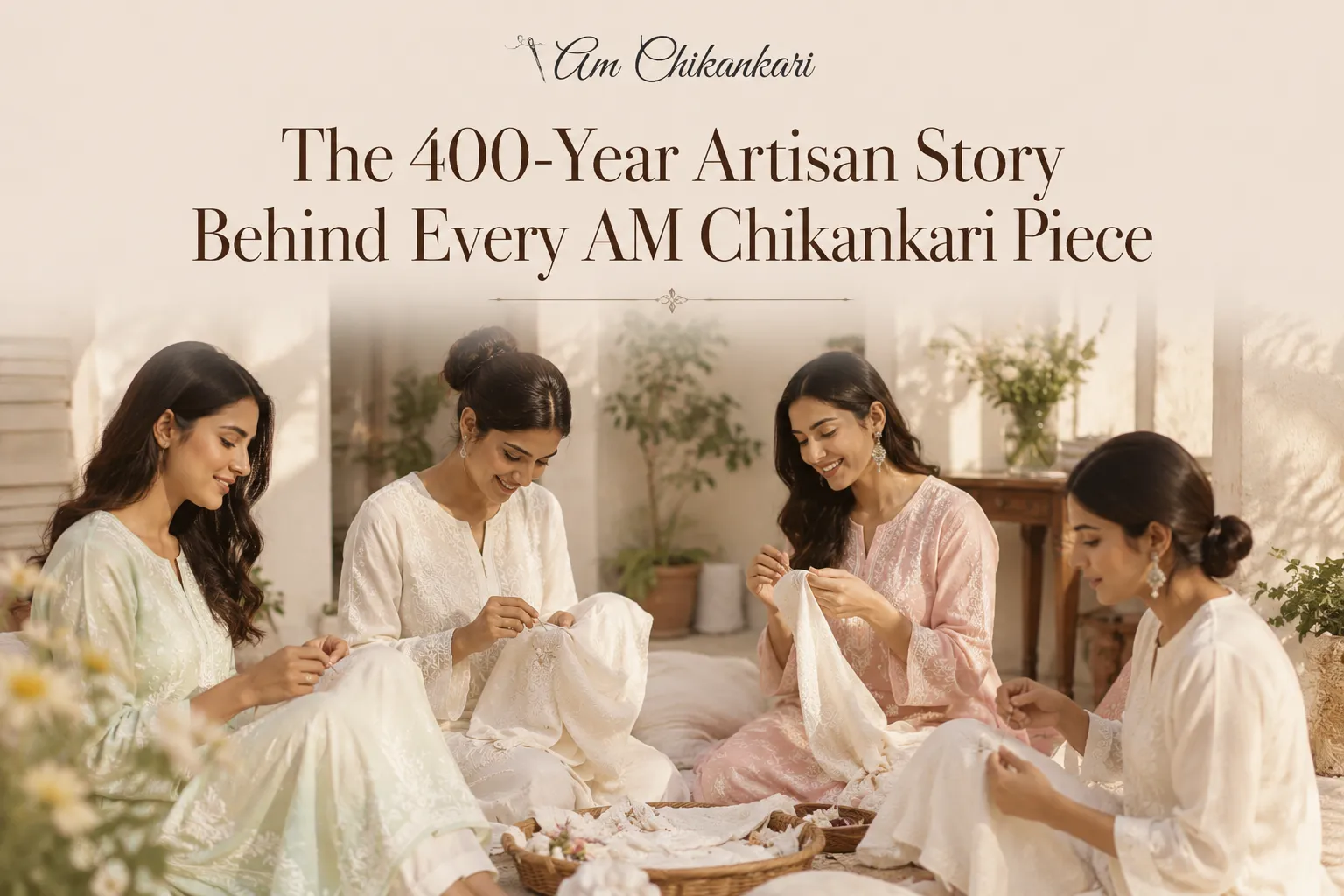
The 400-Year Artisan Story Behind Every AM Chikankari Piece
Who made your kurta. How they learned. What they earn. Why buying from AM Chikankari is a direct act of support for one of India's most important living craft traditions.
TABLE OF CONTENTS
1. A Morning in the Lanes of Chowk, Lucknow
2. The 400-Year History - From Mughal Courts to Your Wardrobe
3. The Craft Ecosystem - 250,000 Artisans and How It Actually Works
4. The Women Who Hold the Craft
5. The Technical Language - The 36+ Named Stitches
6. The Economics - Why Fair Wages Matter for Quality
7. AM Chikankari's Artisan Partnership - What Direct Sourcing Actually Means
8. The GI Tag's Role in Protecting Artisan Livelihoods
1. A Morning in the Lanes of Chowk, Lucknow
The lane is narrow enough that two motorcycles cannot pass each other without one slowing to a crawl. The plaster on the walls is the colour of old turmeric. The buildings lean slightly toward each other so the lane stays shaded until late morning. From behind a door with blue painted trim - second house on the left, ground floor - comes a faint, rhythmic sound: the quiet tap of a needle being pushed through fabric, drawn through, repositioned, pushed through again.
Nasreen, forty-two years old and the mother of two daughters, has been embroidering since she was eight. She learned from her mother, who learned from her grandmother. The house they live in is the house her grandmother embroidered in, in the same lane. Nasreen does not think of this as remarkable. She thinks of it as her work, her craft, and in some way that does not need articulating, her identity.
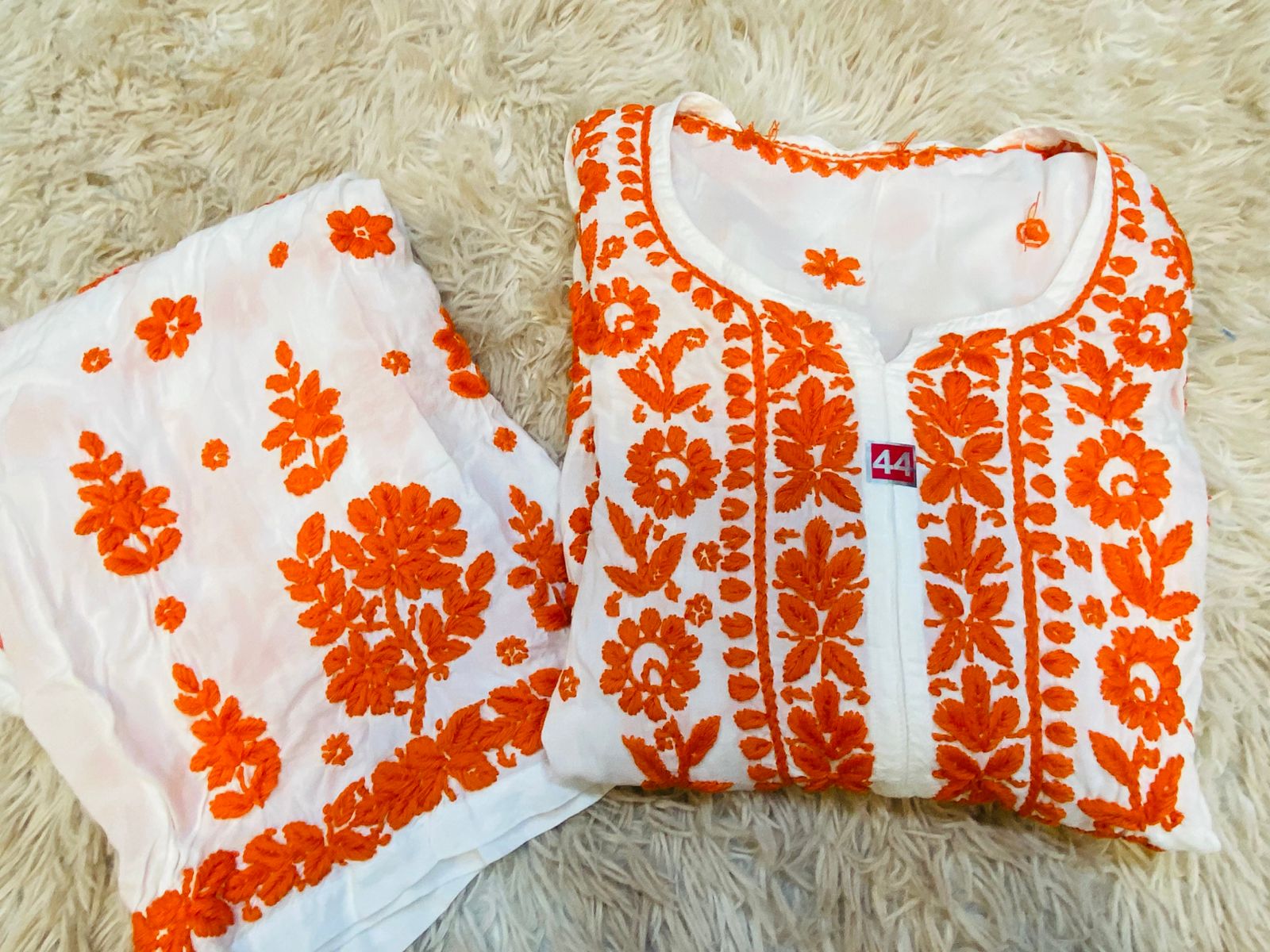
The piece she is working on today is a kurti headed for AM Chikankari's festive collection - a deep teal chanderi with a flowing floral design in the traditional Chikankari vocabulary. The pattern was transferred to the fabric earlier in the week using hand-carved wooden blocks and a washable paste - the traditional resist-printing method that Lucknow embroiderers have used for centuries. Nasreen is responsible for the bakhiya shadow work that forms the heart of the design - the undulating stitch from the underside of the fabric that will glow through the fine chanderi when held to light. She will spend four days on this piece. She has made hundreds of pieces like it, with variations, across thirty-four years.
This is where your AM Chikankari piece begins. Not in a factory. Not in a machine. In a lane in Lucknow, in a house where three generations of the same family have practiced the same craft.
"Char sau saal ki yeh dharohar, suiyon mein band hai, Nasreen ke haath yeh kaam karte, duniya mein pehchaan hai, Jo pehne AM Chikankari, woh itihas ko pehne hai, Lucknow ki mitti ka noor, har dhage mein rehne hai." Four hundred years of heritage are locked in these needles. Nasreen's hands do this work - known to the world. Whoever wears AM Chikankari wears history itself. The light of Lucknow's earth lives in every thread.
2. The 400-Year History - From Mughal Courts to Your Wardrobe
Chikankari's history in Lucknow is documented, specific, and uninterrupted. The craft appears in Mughal administrative records and court chronicles from the early 17th century, during the reign of Emperor Jahangir. Multiple historical sources credit Nur Jahan - Jahangir's empress, a woman of extraordinary political intelligence and aesthetic refinement who effectively co-ruled the Mughal empire for significant portions of Jahangir's reign - with the active patronage and development of the craft at the Mughal court.
The connection between Chikankari and Lucknow became permanent and defining under the Nawabs of Awadh in the 18th and 19th centuries. The Nawabi court of Lucknow - celebrated across the subcontinent for its extraordinary cultural sophistication in every area of life: Urdu poetry, classical music, the courtly language called Lakhnawi, the food traditions that gave us biryani and kebab, the dress aesthetic that was emulated from Delhi to Hyderabad - made Chikankari the defining textile art of their civilisation.
Under Nawabi patronage, Chikankari developed from a technique with a limited vocabulary into one of the most complex and codified hand-embroidery traditions in the world. The number of recognised and named stitches expanded to over 36. Specialised artisan communities developed around specific techniques. A commercial structure grew up around the craft that extended from the lanes of old Lucknow to buyers across the subcontinent, to British colonial administrators who sent the finest pieces back to London, to the Paris fashion houses that took notice of "Dacca muslin" and its extraordinary embroidered expressions.
All of this history - four hundred years of patronage, practice, refinement, and continuity - is present in the piece Nasreen is working on today. When you wear AM Chikankari, you are wearing a four-century art form. That is not a marketing claim. It is a verifiable historical fact.
3. The Craft Ecosystem - 250,000 Artisans and How It Actually Works
The Lucknow Chikankari industry today supports an estimated 250,000 artisans, primarily women, working in and around the city. This is the largest concentration of hand-embroidery skill in any single city in Asia. To understand what AM Chikankari is buying and how it reaches you, you need to understand how this ecosystem actually functions.
The production model for authentic Chikankari is decentralised by design - and this is not a weakness but a deliberate architecture suited to the craft's specific requirements. Rather than centralised factories, Chikankari production operates through a network of small artisan clusters: families, neighbours, mohalla groups, each of whom cover a specialised part of the full technical vocabulary. A single AM Chikankari kurta may pass through the hands of three or four different artisan specialists before it is complete:
First, the fabric is prepared and the design is transferred by the block printer - a separate specialist who carves wooden blocks to the design specifications and applies the washable pattern paste. Then the fabric goes to the tepchi artisan for the foundational running stitch work. Then to the bakhiya specialist for the shadow work that defines the design. Then to the murri and phanda specialists for the texture stitching within the floral motifs. Finally, for our premium pieces, to the specialty technique artisan - keel kangan, khatau, or Mukesh work.
Each artisan in this chain does one thing and does it exceptionally. This is not inefficiency. It is the mechanism through which the highest quality is produced - specialists working at the level that years of dedicated practice with a single technique makes possible. A murri artisan who has done nothing but murri stitching for fifteen years produces murri that a generalist embroiderer working across all techniques cannot match.
4. The Women Who Hold the Craft
Approximately 70% of Lucknow's Chikankari artisans are women. For the majority of these women, Chikankari is their primary or sole source of independent income. The decentralised, home-based production model of Chikankari is particularly well-suited to women who are primary caregivers - they can work around family responsibilities, school schedules, domestic demands, without sacrificing income or professional continuity.
This makes Chikankari one of India's most significant women's economic empowerment ecosystems - not by policy design but by the natural alignment of the craft's production structure with the reality of women's lives in semi-urban North India. When you buy authentic Chikankari from AM Chikankari, the economic benefit of that purchase flows predominantly to women artisans in their homes in the lanes of Lucknow. Not to shareholders. Not to factory owners. To the women whose hands made it.
AM Chikankari is itself a 90% women-led brand. Our team is predominantly women. Our artisan partners are predominantly women. Our customer base is predominantly women. This is not a stated value - it is an operational reality. The craft has always been women's work, and the business built around it is women's work too.
5. The Technical Language - The 36+ Named Stitches
To understand the genuine achievement of a well-made Chikankari piece, you need to understand the breadth of the technical vocabulary that goes into it. Here is a thorough account of the principal stitches and techniques:
- The Foundation Stitches
Tepchi is the long, even running stitch that forms the structural backbone of most Chikankari designs - the first pass of thread that outlines and fills the major design elements. Consistent tension and direction in tepchi is the first challenge every Chikankari apprentice faces and the last one that is ever fully mastered. The difference between tepchi worked by a five-year practitioner and a thirty-year practitioner is immediately visible to a trained eye.
Bakhiya is the defining technique of Lucknow Chikankari - worked entirely from the underside of the fabric to create the shadow effect visible through fine cotton on the right side. In natural light, this creates the luminous, floating quality that makes authentic Chikankari immediately distinguishable from any imitation. No current technology can replicate this effect because it is created by physical thread structure, not surface application.
Ulta Bakhiya is the reverse variant of standard bakhiya - creating a double-sided shadow effect visible from both sides of the garment. Used in the most celebrated and most technically demanding Chikankari pieces, pieces that can be worn with either side as the right side.
- The Texture Stitches
Murri are tiny, rice-grain-shaped knots formed by wrapping thread around the needle before pulling through the fabric. Built up in clusters of dozens to hundreds across a design, murri creates the textured surface quality of stamens, seeds, and fine floral detail that makes Chikankari palpably different from a flat printed surface. A skilled murri artisan works at speed, each knot forming in a single controlled movement of the hand.
Phanda are smaller than murri - barely individually visible, devastating in their cumulative effect when built up in dense fields of hundreds. Phanda creates the soft textural suggestion of gathered petals, fine grain, and the luminous depth of flowers seen close up.
Gitti is a knot stitch variant used for specific textural effects within floral designs - slightly different in formation from murri, used by experienced artisans to create visual variation within a field of knot stitching.
- The Linear and Chain Stitches
Rahet is a chain stitch used for flowing curved lines - particularly in petal outlines and decorative borders. The rahet creates a continuous, slightly raised line with an organic flowing quality that distinguishes it from simpler running stitches.
Zanzeera is a fine chain stitch variant used for narrow, intricate borders and linear detail work - typically in borders less than three millimetres wide. Requires exceptional control to execute at this small scale consistently.
Jali is the openwork technique where threads of the fabric itself are drawn aside and stitched around to create a lattice of small, regular holes through the fabric. Jali work requires both precision thread manipulation and careful measurement - a jali border on a fine mulmul kurta is among the most demanding work in the Chikankari vocabulary.
- The Specialty and Dimensional Techniques
Keel Kangan creates raised, three-dimensional embroidery by layering multiple passes of thread on the fabric surface - building design elements upward stitch by stitch to create sculptural depth. Keel kangan elements in a design have a quality that is both visible and palpable - you can see the dimension in photographs and feel it under your fingers.
Khatau is an applique technique where precisely cut pieces of fabric are stitched to the base cloth to create layered, dimensional design elements. It requires both embroidery precision and cutting precision - two separate skill sets that are rarely equally developed in one artisan.
Turpai is a hemstitch variant that creates delicate, regular openwork at borders and edges - drawn threadwork of considerable technical complexity. Turpai borders on premium pieces are among the most time-intensive elements in the craft.
6. The Economics - Why Fair Wages Matter for Quality
The relationship between artisan wages and embroidery quality in the Chikankari sector is direct, unavoidable, and frequently ignored in discussions of the craft. This is not a moral argument about fairness - it is a practical argument about outcomes. Below-market wages incentivise artisans to work faster, which means less time on small stitches, wider spacing between murri knots, less care in the shadow stitching, less precision in the keel kangan detail work. Above-market wages allow artisans to take the time to do the work the way they know it should be done.
AM Chikankari pays wages above the Lucknow market rate across every artisan category we work with. We do this because we have seen directly and consistently over years of working in this ecosystem that the quality of work produced at fair wages is measurably better than work produced at below-market rates. This is not charity - it is rational quality procurement. We get better embroidery by paying better wages. The embroidery in your AM Chikankari piece reflects that commitment.
Our artisans work on a revenue-sharing model rather than a simple per-piece rate - they receive a percentage of the sale value of pieces they embroider. This means our artisans have a direct stake in the quality and commercial success of every piece, and their income rises as AM Chikankari grows. This is not a standard practice in the Chikankari sector. We believe it should become one.
7. AM Chikankari's Artisan Partnership - What Direct Sourcing Actually Means
The phrase "directly sourced from artisans" appears in many brand descriptions and means different things in different contexts. For AM Chikankari, it means specifically: we do not source through the traditional broker-intermediary chain that characterises most commercial Chikankari procurement. We work directly with artisan clusters, visiting our producers, building long-term relationships with specific groups of specialists, commissioning work at design stages rather than buying from finished stock, and providing consistent work flow across seasons.
The traditional Lucknow Chikankari market operates through a chain of intermediaries - from artisan to karkhana (workshop owner) to trader to exporter to brand - each of whom takes a margin, compresses the artisan's wage, and distances the eventual buyer from the person who made their piece. AM Chikankari's model removes as much of this chain as practically possible. Our customers' money reaches the artisans who made their piece in significantly higher proportion than is standard in the sector.
When you buy Gunjan Purple 3-Piece Set, the artisans who embroidered the kurti, palazzo, and dupatta receive a share of that purchase. When you buy the Sneha White 3D Embroidery Set, the murri specialist, the bakhiya specialist, and the keel kangan artisan who worked on that piece each receive their share. This direct connection between buyer and maker - even mediated through a commercial platform - is the basis of AM Chikankari's existence.
8. The GI Tag's Role in Protecting Artisan Livelihoods
The Geographical Indication tag awarded to Lucknow Chikankari in 2008 has practical importance for artisan livelihoods that goes beyond its role as a consumer authenticity marker. GI protection, properly enforced, ensures that the premium market value associated with the Lucknow Chikankari name flows to artisans in the Lucknow cluster rather than being captured by producers elsewhere who use the name without the craft.
The challenge is enforcement - which is expensive, legally complex, and practically difficult at the scale of hundreds of thousands of online listings that misuse the Chikankari name. Government enforcement capacity has not matched the scale of the problem. The more effective mechanism, in practice, is consumer education: buyers who know how to identify authentic Chikankari, who understand what they are paying for, and who actively choose genuine craft over imitation. Every informed buyer is enforcement of the GI tag's intent.
When you buy from AM Chikankari and understand why you are buying from AM Chikankari, you are participating in the economic ecosystem that keeps Nasreen working, that will allow her daughters to learn the craft from her, and that maintains the living thread of four hundred years of artisan knowledge in the lanes of Lucknow. That is what your purchase does. That is the story behind every piece.
Explore every piece in AM Chikankari's collection - each one hand-embroidered by the artisan community described in this guide - at amchikankari.com.